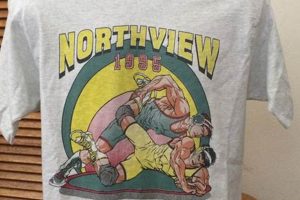
Apparel featuring the Drug Abuse Resistance Education (D.A.R.E.) program, particularly those produced during its initial widespread implementation, can be classified as collectible memorabilia. These garments, often t-shirts, served as a visible symbol of participation in the program aimed at educating students about the dangers of drug use. A typical example would be a screen-printed shirt featuring the D.A.R.E. logo, often an emblem of a lion, alongside slogans promoting drug-free living.
The significance of these items lies in their representation of a specific era in drug education and prevention. They offer insights into the strategies employed during the late 20th and early 21st centuries and can serve as a tangible connection to a program that impacted countless students. From a historical perspective, these articles of clothing provide valuable context for understanding societal attitudes towards drug use and the methods used to combat it. Furthermore, the nostalgia associated with these items can be a powerful factor in their appeal.
Therefore, analysis of the construction, design elements, and cultural context of these items provides a framework for understanding their value and significance within broader historical and social narratives. Subsequent sections will explore design variations, identifying characteristics of particular eras, and evaluating their collectibility within a niche market.
Acquiring and Preserving D.A.R.E. Apparel
The acquisition and preservation of vintage D.A.R.E. apparel requires careful consideration to ensure its longevity and maintain its value as a historical artifact. This section outlines practical strategies for collectors and enthusiasts.
Tip 1: Authenticate the Garment: Examine the manufacturing tags for clues regarding the era of production. Older shirts often feature tags with specific brand names or union labels common to their time. Research vintage tag databases for verification.
Tip 2: Assess Condition Meticulously: Evaluate the fabric for signs of wear, discoloration, or damage. Pay close attention to the screen-printed design, noting any cracking, fading, or peeling. Minor imperfections are typical of vintage items, but significant damage can detract from the value.
Tip 3: Determine Rarity Factors: Limited edition designs, regional variations, or shirts associated with specific events may command a higher price. Research the historical context of the garment to identify any unique attributes.
Tip 4: Implement Proper Storage Techniques: Store items flat in acid-free archival boxes or hanging in garment bags made of breathable materials. Avoid direct sunlight, excessive humidity, and extreme temperatures to prevent degradation of the fabric and design.
Tip 5: Handle with Care During Cleaning: When cleaning is necessary, opt for hand washing with a mild detergent specifically formulated for delicate fabrics. Avoid harsh chemicals, bleach, and machine drying, as these can cause irreparable damage.
Tip 6: Document the Acquisition: Maintain a detailed record of each garment, including its origin, condition, and any relevant historical information. This documentation will enhance its provenance and value for future collectors.
Implementing these strategies will aid in both acquiring authentic garments and ensuring their preservation for future generations. By understanding the nuances of vintage apparel, collectors can responsibly manage their collections.
The following section will explore market trends and valuation techniques for vintage D.A.R.E. apparel.
1. Nostalgia

The enduring appeal of vintage D.A.R.E. shirts is inextricably linked to the phenomenon of nostalgia. For individuals who participated in the D.A.R.E. program during their formative years, these shirts serve as tangible reminders of that specific period. The inherent connection stems from the program’s ubiquitous presence in schools throughout the United States during the late 1980s and 1990s, making it a shared cultural experience for many. This shared experience fosters a sense of collective memory, where the shirt acts as a trigger, eliciting recollections of classroom sessions, interactions with law enforcement officers, and the general cultural climate surrounding drug education at the time. The emotional attachment to these memories subsequently imbues the garment with a value that transcends its mere material composition.
The importance of nostalgia as a component of the appeal can be demonstrated through market trends. Online auction platforms and vintage clothing marketplaces frequently showcase these items, and their sales often correlate with significant anniversary dates related to the D.A.R.E. program or broader societal interest in revisiting the era. Furthermore, social media groups dedicated to 1980s and 1990s nostalgia often feature images and discussions centered around these garments, indicating a sustained interest and emotional resonance. Understanding this connection allows collectors and sellers to better appreciate the factors driving the value and desirability of such items. For instance, a seller highlighting the shirts potential to evoke specific childhood memories may attract a buyer motivated by nostalgia.
In summary, nostalgia plays a crucial role in the sustained demand for vintage D.A.R.E. shirts. This emotional connection transforms a simple piece of apparel into a potent symbol of a specific historical period and personal experience. While accurately gauging the emotional impact of any item presents a challenge, recognizing the central role of nostalgia provides a crucial lens through which to understand the market for these collectibles and their broader cultural significance.
2. Iconography
The visual elements present on vintage D.A.R.E. shirts are critical components in understanding their historical significance and cultural impact. These graphic elements, collectively termed iconography, serve as visual shorthand for the programs aims, values, and overall message. Examining these visual components provides insight into the D.A.R.E. program’s strategies for engaging with its target audience and disseminating its anti-drug message.
- The Lion Logo
The D.A.R.E. program’s lion mascot is arguably its most recognizable symbol. Often depicted wearing a D.A.R.E. t-shirt itself, the lion served as a friendly and approachable figure designed to resonate with children. Its presence on shirts reinforced the program’s message of courage and strength in resisting peer pressure and making healthy choices. For example, a shirt featuring the lion giving a thumbs-up would visually reinforce the idea that choosing a drug-free life is a positive and commendable decision.
- Slogans and Catchphrases
Common slogans, such as “D.A.R.E. to Keep Kids Off Drugs” or “Drug-Free is the Way to Be,” were frequently incorporated into the design. These concise phrases served as memorable and easily digestible messages that reinforced the programs core principles. The repetition of these slogans on apparel contributed to their widespread recognition and association with the D.A.R.E. program. A shirt emblazoned with a simple, bold slogan would function as a walking advertisement for the anti-drug message.
- Color Palette and Design Aesthetics
The color schemes and overall design aesthetics of these shirts often reflected the prevailing trends of the era in which they were produced. Bright, vibrant colors and bold graphics were commonly used to capture the attention of young people. Certain design elements, such as geometric patterns or cartoonish illustrations, further contributed to the shirts’ appeal. The use of a specific font or the placement of graphics could signal the garment’s age and origin, reflecting design sensibilities of the time.
- Variations and Regional Adaptations
Iconography could vary depending on the region or specific initiative associated with the D.A.R.E. program. Some shirts might incorporate local law enforcement logos or slogans tailored to address specific drug-related issues in the community. These regional variations highlight the adaptability of the D.A.R.E. program and its efforts to connect with local audiences. A shirt featuring a police department badge alongside the D.A.R.E. logo would represent a localized partnership in drug prevention.
In conclusion, the visual components of vintage D.A.R.E. shirts are more than mere decoration; they represent a deliberate strategy to communicate a message, engage with a specific audience, and reinforce the values of the D.A.R.E. program. By analyzing the iconography, a deeper understanding of the program’s impact and its place in American cultural history can be achieved. This understanding strengthens the case for these garments as significant artifacts worthy of collection and preservation.
3. Rarity
The scarcity of specific examples significantly influences the value and collectibility of vintage D.A.R.E. shirts. Variations in design, production runs, and distribution contribute to the relative rarity of individual items, impacting their desirability within the collector market. Several factors contribute to the relative rarity of these shirts.
- Limited Edition Prints
Certain D.A.R.E. shirts were produced in limited quantities, often for specific events or promotional campaigns. These shirts typically feature unique designs or color schemes not found on standard production models. For example, a shirt produced for a regional D.A.R.E. graduation ceremony with a limited print run would be significantly rarer than a mass-produced design available nationwide. Their scarcity increases their value among collectors.
- Regional Variations
The D.A.R.E. program operated with a degree of local autonomy, resulting in regional variations in shirt designs. These variations might include the incorporation of local law enforcement logos, slogans specific to the region, or designs that reflected local cultural elements. A shirt featuring a police department logo from a small town that no longer exists would be considered rare due to its limited distribution and historical context.
- Production Era
Shirts produced during the D.A.R.E. program’s peak in the late 1980s and early 1990s are generally more common than those produced in later years, when the program’s funding and popularity declined. Early examples, especially those in good condition, are more sought after by collectors. A shirt from 1983, the year of the program’s inception, would inherently be rarer than a shirt from 1993.
- Condition
While not directly a factor of initial production, the condition of a vintage shirt significantly impacts its rarity. Shirts in pristine condition, free from stains, tears, or significant fading, are considerably rarer than those showing signs of heavy wear. The survival rate of vintage clothing in excellent condition is naturally low, making well-preserved examples highly desirable. A shirt that has been carefully stored and never worn would command a premium due to its exceptional condition and relative scarcity.
The confluence of these factorslimited production, regional variations, production era, and conditiondetermines the overall rarity of a given vintage D.A.R.E. shirt. Collectors prize rarity as it signifies unique historical context and limited availability, ultimately influencing market value and desirability.
4. Condition

The physical state of vintage D.A.R.E. shirts directly and significantly impacts their value and desirability within the collectors’ market. The assessment of condition involves a detailed examination of various factors that contribute to the overall integrity and appearance of the garment.
- Fabric Integrity
The structural soundness of the fabric is paramount. Tears, holes, or excessive thinning compromise the shirts integrity and diminish its value. A shirt with significant fabric damage is less desirable due to its compromised structural integrity. Examination involves checking for weakened areas, especially at seams, collars, and cuffs. The presence of dry rot or moth damage will substantially reduce the item’s worth.
- Print Quality and Fading
The vibrancy and clarity of the screen-printed design are critical. Fading, cracking, or peeling of the print detracts from the shirts visual appeal and lowers its value. An ideal specimen retains sharp, well-defined graphics with minimal degradation. Evaluation involves observing the color saturation and adhesion of the print to the fabric. Substantial fading or extensive cracking renders the design less legible and reduces the garment’s appeal.
- Stains and Discoloration
The presence of stains or discoloration negatively affects the shirts overall appearance and perceived value. Stains from spills, sweat, or prolonged exposure to sunlight can be difficult to remove and may permanently alter the fabric’s color. Uniform discoloration, often resulting from improper storage, can also diminish the shirts aesthetic appeal. A shirt exhibiting noticeable stains or widespread discoloration is less desirable than one in pristine condition. The nature and severity of the stains will directly correlate with the reduction in value.
- Original Tags and Labeling
The presence of original manufacturing tags and labeling enhances the authenticity and value of the shirt. These details provide valuable information about the shirts production era, materials, and brand. Intact tags and labels signify that the shirt has been well-preserved and contribute to its overall collectibility. The absence of these elements may raise concerns about the shirts originality or history.
Collectively, these aspects of condition dictate the overall value and desirability of a vintage D.A.R.E. shirt. Garments in excellent condition command higher prices and are more sought after by collectors. The assessment of condition requires careful attention to detail and a thorough understanding of the factors that contribute to the shirts long-term preservation.
5. Provenance
Provenance, in the context of a vintage D.A.R.E. shirt, refers to the documented history of ownership and origin of the garment. It establishes a verifiable chain of custody, linking the shirt to a specific time, place, and potentially, an individual. The strength of a shirt’s provenance directly influences its value and desirability among collectors. A shirt with a clear and compelling history possesses a narrative absent in items with unknown or unverifiable backgrounds. For instance, a D.A.R.E. shirt accompanied by a photograph of the original owner wearing it at a school event in 1988, along with a signed letter attesting to its history, holds significantly greater value than an identical shirt lacking such documentation. The documentation mitigates the risk of misrepresentation and enhances the perceived authenticity, thus improving the value as a result.
The practical significance of understanding provenance extends beyond mere valuation. It allows for a deeper appreciation of the artifact as a cultural object. A shirt worn by a D.A.R.E. officer actively involved in establishing the program in a particular community offers insights into the programs implementation and impact at the local level. Similarly, a shirt originating from a school district known for its innovative approach to drug education provides valuable context for understanding the shirt within the broader history of drug prevention strategies. Effective investigation of the history of the garment, to prove if it part of specific event, will make the shirt value increases dramatically.
Establishing a complete and verifiable provenance presents challenges. Records may be incomplete or non-existent, and memories fade over time. However, diligent research, including examination of school yearbooks, local news archives, and interviews with individuals involved in the D.A.R.E. program, can often uncover valuable information. The effort invested in tracing the history of a vintage D.A.R.E. shirt significantly enhances its historical and cultural value, transforming it from a simple piece of apparel into a tangible link to a specific moment in time. In essence, a verifiable provenance transforms the garment from a commodity into a historical asset.
Frequently Asked Questions
The following questions address common inquiries regarding the identification, valuation, and preservation of vintage apparel related to the Drug Abuse Resistance Education (D.A.R.E.) program.
Question 1: How can the authenticity of a purported vintage D.A.R.E. shirt be verified?
Authentication involves examining manufacturing tags for era-specific brand names and union labels. Consulting vintage tag databases and comparing design elements to known examples from specific periods can aid in verifying authenticity.
Question 2: What factors influence the valuation of a vintage D.A.R.E. shirt?
Valuation is determined by a combination of factors, including condition, rarity, design, and provenance. Shirts in excellent condition with unique designs or documented historical significance command higher prices.
Question 3: What constitutes a rare vintage D.A.R.E. shirt?
Rarity is typically associated with limited edition prints, regional variations, shirts produced during specific events, or items from the early years of the D.A.R.E. program.
Question 4: How should vintage D.A.R.E. shirts be properly stored to prevent damage?
Proper storage involves storing shirts flat in acid-free archival boxes or hanging in breathable garment bags. Direct sunlight, excessive humidity, and extreme temperatures should be avoided to prevent fabric degradation.
Question 5: Is it advisable to wash a vintage D.A.R.E. shirt?
Washing should be approached with caution. Hand washing with a mild detergent formulated for delicate fabrics is preferred. Harsh chemicals, bleach, and machine drying should be avoided.
Question 6: Where can vintage D.A.R.E. shirts be acquired or sold?
Acquisition and sale typically occur through online auction platforms, vintage clothing marketplaces, and specialty vintage shops. Accurate descriptions and detailed photographs are essential for successful transactions.
Understanding these factors enables collectors and enthusiasts to responsibly manage and appreciate vintage apparel associated with the D.A.R.E. program.
The following section will provide a conclusion, summarizing key insights discussed within this article.
Conclusion
The preceding exploration has demonstrated that the “vintage dare shirt” transcends its basic function as mere apparel. It serves as a tangible artifact representing a specific period in American cultural history, particularly concerning drug education and prevention strategies. Analysis of design elements, historical context, and market trends reveals the garment’s significance as a collectible item and a reflection of societal attitudes toward drug use. The intrinsic value of each piece is determined by its condition, provenance and rareness.
Further research into the social and political factors influencing the D.A.R.E. program will undoubtedly provide further insight into the cultural impact of these items. Collectors, historians, and anyone interested in American social history are encouraged to document and preserve these relics of the past. Preservation efforts will solidify the role of the “vintage dare shirt” as a reminder of the past.