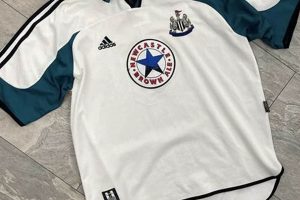
Apparel from the Seattle Mariners baseball team, originating from past eras, is frequently sought after by collectors and fans. These items represent specific periods in the team’s history and often feature designs, materials, and player names unique to their time of production. An example includes a 1980s jersey featuring the team’s original trident logo.
Such memorabilia holds significance as tangible links to the team’s evolution, player legacies, and memorable seasons. Owning a garment from a specific year allows enthusiasts to connect with the team’s past and celebrate pivotal moments. These items can appreciate in value, particularly those associated with iconic players or significant achievements.
The following sections will delve into aspects of identification, valuation, and preservation of these historical athletic garments, offering guidance for enthusiasts and collectors alike. Information on prominent designs, player associations, and market trends will also be provided.
Guidance on Acquiring Historical Seattle Mariners Apparel
The following guidance assists in the identification and evaluation of historical Seattle Mariners apparel, promoting informed acquisitions and responsible stewardship.
Tip 1: Authenticate Manufacturing Details: Examine tags, stitching, and material composition. Official MLB apparel typically displays manufacturing trademarks and identifiers corresponding to its era. Discrepancies may indicate reproductions or unauthorized items.
Tip 2: Verify Player and Number Accuracy: Cross-reference player numbers and name spellings with historical team rosters. Misspellings or incorrect number assignments are indicators of inauthenticity.
Tip 3: Assess Condition Judiciously: Evaluate the garment’s condition relative to its age. Minor wear may be acceptable, but significant damage, excessive fading, or alterations can diminish value.
Tip 4: Research Historical Design Variations: Familiarize yourself with the team’s uniform evolution. Variations in logos, fonts, and striping patterns can help determine the garment’s period of origin.
Tip 5: Compare Prices Across Reputable Sources: Consult auction archives, collector databases, and established memorabilia dealers to gauge fair market value. Beware of prices that deviate significantly from established trends.
Tip 6: Scrutinize Provenance When Available: Documentation linking the garment to a specific player or event enhances its value and authenticity. Letters of authenticity from reputable sources can be beneficial.
By implementing these guidelines, collectors can increase the likelihood of acquiring authentic and valuable historical Seattle Mariners apparel, contributing to the preservation of the team’s legacy.
The subsequent section will discuss proper storage and preservation techniques to maintain the integrity of such acquisitions.
1. Era Authenticity

Era Authenticity constitutes a foundational criterion in the assessment of apparel representing the Seattle Mariners from previous seasons. Establishing the genuine period of origin for an athletic garment directly impacts its value and historical relevance. Inconsistencies between design elements, manufacturing characteristics, and the purported year of production render an item suspect, potentially indicating reproduction or misrepresentation. For instance, a jersey advertised as dating from the 1980s but exhibiting a tagging system introduced in the 1990s would lack Era Authenticity.
The impact of verifying Era Authenticity extends beyond monetary valuation. It ensures that collectors and enthusiasts acquire items accurately representing the team’s visual identity and sporting context during a specified timeframe. The trident logo, employed by the Mariners from their inception until 1986, serves as a marker for dating examples of the apparel. The style and material of the jersey, along with the font of numbers and player names, further aid in authenticating the item’s age.
Accurate identification of Era Authenticity requires attention to detail and diligent research. Consulting official team publications, uniform guides, and reputable memorabilia experts provides the necessary framework. Failure to ascertain the garment’s correct period compromises its historical value and authenticity, underscoring the critical importance of this step in the appraisal process.
2. Logo Variations

The Seattle Mariners’ visual identity has evolved throughout their history, with distinct logo variations appearing on team apparel across different eras. These variations are crucial in determining the age and authenticity of memorabilia, particularly when assessing apparel from previous seasons.
- Trident Era (1977-1986)
The inaugural logo featured a stylized trident, a symbol of maritime power and Seattle’s coastal location. This design is most commonly found on the team’s earliest apparel. The presence of this logo is a strong indicator that the garment originates from the initial decade of the team’s existence. Differences in the trident’s size, color, or placement may indicate specific years within this era, or potentially, unauthorized reproductions.
- Compass Rose Era (1987-1992)
The Mariners transitioned to a compass rose logo, incorporating the team’s name and a baseball. This design represented a shift in the team’s branding and appeared on apparel from the late 1980s and early 1990s. The compass rose may appear in varying sizes and colors depending on the specific year and garment type. Any discrepancies in these visual elements compared to documented team uniforms of the time may raise concerns regarding authenticity.
- Northwest Green Era (1993-2000)
The introduction of “Northwest Green” as a primary color coincided with a modernized logo featuring a stylized letter “M” incorporating a compass. Apparel from this period often displays this logo prominently. Minor variations in the color shades of the green, the font used for the team name, or the stitching patterns can help pinpoint the garment’s precise year of manufacture.
- Current Logo (2001-Present)
The current logo retains the “M” with a compass design but features a darker navy blue and silver color scheme. While not technically “vintage,” these later designs are still subject to variations and counterfeiting. Examining the logo’s precise dimensions, color saturation, and stitching quality is essential for authenticating garments from this more recent period.
Examining specific logo variations is fundamental to establishing the provenance of these items. A careful review of the logo style in relation to the supposed manufacturing year assists in authenticating the vintage apparel, or identifying potential forgeries.
3. Player Association

The linkage between a historical Seattle Mariners garment and a specific player elevates its collectibility and market value. This association provides a tangible connection to the team’s history and individual player legacies.
- Iconic Players and Hall of Fame Induction
Jerseys linked to players inducted into the Baseball Hall of Fame command premium prices. For example, a jersey attributed to Ken Griffey Jr. from his tenure with the Mariners holds significant value due to his status as an iconic player and his Hall of Fame enshrinement. Documentation verifying his use of the garment further increases its desirability among collectors.
- Memorable Moments and Game-Worn Attribution
Apparel worn during significant games or moments in Mariners history gains enhanced appeal. A jersey worn by Edgar Martinez during a pivotal playoff game, such as the 1995 ALDS, would be highly sought after. Provenance establishing the garment’s presence during such an event substantially increases its value and historical importance.
- Rookie Season Apparel
Jerseys from a player’s rookie season often hold special significance. A garment worn by Alex Rodriguez during his early years with the Mariners would attract collector interest, as it represents the genesis of his career. The player’s subsequent achievements add to the allure of these initial-season items.
- Autograph Authentication
The presence of a player’s authenticated autograph on a vintage Mariners jersey enhances its value. The autograph’s legitimacy must be verified through reputable authentication services. An autographed jersey serves as a direct link to the player and confirms their association with the specific garment.
These facets of Player Association underscore the importance of establishing a verifiable connection between a historical Seattle Mariners jersey and a specific player. This association not only increases the item’s monetary worth but also strengthens its historical and emotional connection for collectors and fans.
4. Material Integrity
Material Integrity is a critical factor when assessing a historical Seattle Mariners garment, impacting its value, authenticity, and preservation potential. The original fabrics, construction techniques, and applied decorations provide essential information about the garment’s age and origin. Degradation or alteration of these materials can significantly diminish its worth and historical accuracy.
- Fabric Composition and Weave
The type of fabric used, such as wool, cotton, or early synthetics, provides clues to the garment’s era. The weave pattern and fiber content must align with materials commonly used during the team’s specific historical period. For instance, early jerseys were often constructed from wool flannel, while later examples incorporated synthetic blends. Discrepancies in fabric composition compared to documented specifications suggest potential inauthenticity.
- Stitching and Seam Construction
The stitching techniques and seam construction methods employed in the garment’s manufacture are indicative of its age. Vintage jerseys often feature chain stitching or specific serging patterns, which differ from modern techniques. The thread type, stitch density, and seam finishing should be consistent with manufacturing practices of the relevant era. Variations may indicate repairs, alterations, or fraudulent production.
- Color Fastness and Dye Stability
The degree to which the garment’s colors have retained their original vibrancy is a crucial indicator of Material Integrity. Fading, bleeding, or discoloration can result from age, improper storage, or exposure to sunlight and moisture. While some fading is expected in older garments, excessive degradation suggests poor preservation or the use of inferior dyes, impacting the garment’s overall appeal and value.
- Decoration and Lettering Application
The methods used to apply logos, numbers, and player names to the jersey provide further insight into its authenticity. Early jerseys may feature felt lettering sewn directly onto the fabric, while later examples may utilize screen-printing or heat-applied transfers. The type of material used for the decorations, the application technique, and the overall quality of the embellishments should align with manufacturing standards of the garment’s purported era. Inconsistencies raise concerns about originality.
The assessment of Material Integrity, encompassing fabric composition, stitching techniques, color fastness, and decoration methods, is essential to establish the authenticity and value of a historical Seattle Mariners jersey. The presence of original materials in well-preserved condition supports the garment’s historical significance and contributes to its desirability among collectors.
5. Rarity Valuation

Rarity Valuation is a principal determinant in the market assessment of a vintage Seattle Mariners jersey. The principle of scarcity directly influences the price a collector is willing to pay. Limited production runs, unique design elements, or association with significant historical events contribute to a jersey’s rarity. For example, a prototype jersey that never entered mass production would command a significantly higher price than a common retail version from the same era. The intrinsic value lies not only in the jersey’s age but in its limited availability.
Several factors contribute to the Rarity Valuation of these athletic garments. Jerseys worn by iconic players during record-breaking seasons, or those commemorating specific milestones, often exist in limited quantities. Garments with manufacturing errors or design flaws, while initially deemed imperfect, can also become highly sought after due to their unique characteristics. Determining the true rarity necessitates diligent research into production numbers, distribution channels, and surviving examples. Sources include team archives, collector databases, and reputable auction houses.
The practical significance of understanding Rarity Valuation is paramount for both collectors and sellers. Accurate assessment ensures fair market transactions and informed purchasing decisions. Overvaluing a common jersey based on superficial characteristics leads to potential financial loss, while undervaluing a genuinely rare item results in missed opportunities. Consequently, comprehensive knowledge of production specifics, historical context, and surviving populations is essential for navigating the market for vintage Seattle Mariners apparel.
6. Condition Assessment

The evaluation of physical condition is a paramount aspect in determining the value and desirability of apparel associated with the Seattle Mariners from past eras. Garments from previous seasons, due to their age and potential exposure to various environmental factors, invariably exhibit some degree of wear. Assessing the extent and nature of this wear is essential for establishing an accurate valuation and making informed purchasing decisions.
- Fabric Integrity
Fabric integrity assesses the presence of holes, tears, snags, or weakened fibers. The presence and extent of such damage significantly impacts the value. For example, a jersey with a large, irreparable tear across the logo diminishes its desirability, whereas minor wear consistent with age may be acceptable to collectors. Discoloration, staining, and fading also factor into this assessment. Excessive fading can devalue the item, while localized stains may be treatable, potentially improving its condition.
- Seam and Stitching Stability
Seam and Stitching Stability refers to the integrity of the garment’s construction. Broken or loose seams, missing stitches, and unraveling hems impact the garment’s structural soundness and aesthetic appeal. A jersey with extensive seam damage necessitates professional restoration, adding to the overall cost. The presence of original stitching versus repairs also affects value, as originality is often prized by collectors. Replacement stitching should be carefully examined for compatibility with the original construction methods.
- Decoration and Lettering Condition
Decoration and Lettering Condition involves examining the logos, numbers, and player names applied to the jersey. Cracking, peeling, or fading of these embellishments diminishes the garment’s visual appeal and historical accuracy. Damage to these elements may be difficult or impossible to repair without compromising originality. The presence of period-correct lettering and numbering styles contributes to the garment’s authenticity, whereas inconsistent or replaced decorations detract from its value.
- Tag and Label Presence and Legibility
Tag and Label Presence and Legibility contributes to authentication and valuation. Intact, legible tags and labels provide crucial information about the manufacturer, size, and fabric composition. Missing or illegible tags hinder the authentication process and reduce the garment’s value. Tags should be examined for consistency with those used during the garment’s purported era. Counterfeit or reproduction jerseys often exhibit inaccuracies in tag design and information.
These considerations collectively influence the perceived quality and desirability of memorabilia. Appraising vintage jerseys requires a meticulous examination of these facets. The balance between originality and preservation dictates the garment’s value within the collector’s market. A well-preserved item, retaining its essential characteristics, commands a premium over those exhibiting significant damage or alterations.
Frequently Asked Questions
The following questions address common inquiries regarding apparel associated with the Seattle Mariners baseball team from prior seasons, providing clarification on key aspects of identification, valuation, and preservation.
Question 1: How is the age of a Seattle Mariners garment determined?
The age is ascertained through a combination of factors, including logo design, fabric composition, tagging systems, and team uniform history. Cross-referencing these elements with established timelines helps to pinpoint the year of manufacture. Discrepancies may indicate reproductions.
Question 2: What factors contribute to a higher valuation?
Valuation is influenced by rarity, condition, player association, and historical significance. Jerseys worn by iconic players, from limited production runs, or linked to memorable events command higher prices. Preservation condition is also a key determinant.
Question 3: What are the primary indicators of an inauthentic garment?
Inauthenticity is suggested by discrepancies in logo design, incorrect player names or numbers, mismatched tagging systems, and fabric composition inconsistent with the purported era. Deviations from established team uniform specifications serve as red flags.
Question 4: How should vintage baseball apparel be stored?
Storage should occur in a cool, dry environment, away from direct sunlight and extreme temperature fluctuations. Garments should be stored flat or hung on padded hangers to prevent distortion. Acid-free storage materials are recommended.
Question 5: Can damage to an old athletic garment be repaired?
Repairs are possible, but should be undertaken with caution. Professional restoration services specializing in textile conservation are recommended. Improper repair techniques can diminish the garment’s value and historical integrity.
Question 6: Where can authentic articles be sourced?
Sourcing should occur through reputable auction houses, established memorabilia dealers, and knowledgeable collectors. Scrutinizing provenance and seeking authentication from recognized experts are crucial steps in the acquisition process.
Acquiring and maintaining vintage Seattle Mariners apparel requires diligence and informed decision-making. Understanding the factors influencing authenticity, valuation, and preservation is essential for both collectors and enthusiasts.
The subsequent section will delve into resources available for further research and authentication assistance.
Conclusion
The preceding discussion has explored various facets of apparel associated with the Seattle Mariners baseball team from previous eras. Critical aspects examined include authentication methodologies, valuation determinants, and preservation techniques. Specific attention was given to era verification, logo variations, player associations, material integrity, and condition assessment.
Prospective collectors and enthusiasts are encouraged to apply the outlined principles when acquiring or managing historical Seattle Mariners garments. Further research, consultation with experts, and diligent attention to detail are essential to ensure the preservation of these artifacts and their continued appreciation within the sports memorabilia community.