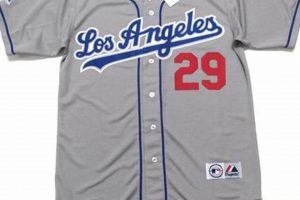
The garment represents a tangible connection to baseball history and the San Francisco Giants franchise. These articles of clothing, often dating back several decades, offer a glimpse into the team’s evolving aesthetic and the eras they represent. Examples include wool flannels from the early years, satin jackets from championship seasons, and various iterations of the team’s colors and logos throughout different periods.
Such memorabilia holds considerable value, both sentimentally and monetarily. They connect fans to specific players, memorable games, and pivotal moments in the team’s past. Their acquisition and preservation reflect an appreciation for baseball heritage. The demand for these items sustains a market driven by collectors, enthusiasts, and those seeking a unique piece of sports history.
The subsequent sections will explore specific features, identifying characteristics, variations in design, and factors that influence the value of these sought-after collectibles. The intent is to provide a comprehensive understanding of the attributes that define the desirability of such a garment.
Tips on Identifying and Preserving a San Francisco Giants Garment
The following guidelines offer insights into authenticating and maintaining a vintage San Francisco Giants garment, ensuring its longevity and preserving its historical significance.
Tip 1: Material Analysis: Examine the fabric composition. Older garments often feature wool or cotton blends, while later examples may incorporate synthetic materials. The type of fabric can offer clues to the garment’s age.
Tip 2: Stitching Examination: Inspect the stitching quality and patterns. Single-needle stitching is characteristic of older garments, while modern examples typically utilize double-needle or serged seams. Deviations from expected stitching styles may indicate a reproduction.
Tip 3: Tag Verification: Scrutinize the tags. Authentic tags include manufacturer information, sizing details, and fabric content. Research known tag variations used by the team’s official suppliers during the suspected period of production.
Tip 4: Logo and Patch Authentication: Compare the logos, patches, and lettering to known examples from the corresponding era. Discrepancies in color, size, or font may indicate a counterfeit item.
Tip 5: Player and Number Font Styles: Research the font styles utilized for player names and numbers during specific seasons. Subtle variations exist, and accurate identification can help verify authenticity.
Tip 6: Storage Considerations: Store the garment in a cool, dry environment away from direct sunlight. Avoid prolonged exposure to humidity or extreme temperatures, which can damage the fabric and cause discoloration.
Tip 7: Cleaning Procedures: Exercise caution when cleaning. Professional dry cleaning is recommended for delicate or antique garments. Avoid harsh chemicals or abrasive cleaning methods.
Tip 8: Professional Appraisal: Seek a professional appraisal from a reputable sports memorabilia expert to determine the garment’s value and authenticity. Their expertise can provide valuable insights and documentation.
Adhering to these guidelines will aid in the proper identification and long-term preservation of these significant pieces of baseball history.
The subsequent sections will delve into the market trends and collecting strategies associated with these coveted items.
1. Authenticity

The verification of authenticity is paramount when acquiring a vintage San Francisco Giants garment. The market contains numerous reproductions and counterfeit items, necessitating a rigorous evaluation process to ensure the legitimacy of a prospective purchase.
- Manufacturer’s Markings
The presence and accuracy of manufacturer’s markings serve as a primary indicator. Official suppliers to the San Francisco Giants, such as McAuliffe, Wilson, and Rawlings, utilized specific tagging and labeling conventions during different eras. Examination of these markings, comparing them to known examples from the period, offers initial verification. The absence of expected markings, or the presence of inaccurate or inconsistent details, raises immediate concerns regarding the item’s authenticity.
- Material Composition and Construction Techniques
The materials and construction techniques employed in the manufacture provide further evidence. Early examples typically feature wool or cotton fabrics, while later garments incorporate synthetic materials. Stitching patterns, seam construction, and the overall quality of workmanship should align with the manufacturing standards of the purported era. Discrepancies in material composition or construction methods, compared to documented practices, suggest a potential lack of authenticity.
- Historical Context and Provenance
Establishing a clear provenance enhances confidence in the item’s authenticity. Documentation such as letters of provenance from former players, team officials, or reputable collectors can provide valuable evidence. Examination of photographic evidence depicting the garment being worn during a specific game or season can further support its legitimacy. While not always available, such historical context significantly strengthens the case for authenticity.
- Expert Authentication
Engaging a professional authenticator specializing in sports memorabilia provides an unbiased assessment. Reputable authenticators possess extensive knowledge of historical manufacturing practices, tagging conventions, and player-specific details. Their examination typically involves a comprehensive review of the garment’s physical characteristics, historical context, and available documentation. A positive authentication opinion from a qualified expert significantly increases confidence in the item’s legitimacy and value.
The diligent application of these authentication criteria serves to mitigate the risk of acquiring a misrepresented vintage San Francisco Giants garment. These steps safeguard the investment and ensure that the acquired item represents a genuine piece of baseball history.
2. Era Identification

The accurate identification of an era is essential when evaluating a vintage San Francisco Giants garment. The item’s age directly influences its value, collectibility, and historical significance. Determining the period of production requires careful analysis of various design elements and manufacturing characteristics.
- Logo Evolution
The team logo has undergone several modifications throughout its history. These changes provide crucial clues for dating the garment. Analysis of the logo’s design, including font styles, color palettes, and overall configuration, helps pinpoint the specific era to which the piece belongs. For instance, the presence of the interlocking “SF” logo with a specific drop shadow indicates a production date within a defined timeframe.
- Color Schemes and Uniform Styles
Uniform colors and styles have varied across different seasons and decades. The colors used, the presence or absence of specific striping patterns, and the overall design of the uniform provide valuable dating information. A black and orange color scheme might suggest a specific period in the team’s history, while the cut and style of the sleeves can further refine the era identification.
- Fabric Composition
The materials utilized in the garment’s construction offer clues to its age. Early examples were typically crafted from wool or cotton, while later items incorporate synthetic fabrics like polyester. The presence of specific materials or blends can narrow down the potential production era. The texture and weave of the fabric can also provide supporting evidence.
- Tagging and Labeling Conventions
Manufacturers’ tags and labels evolve over time. Each company that produced garments for the Giants used specific tagging conventions during different periods. Studying these tags, including the font styles, logos, and information provided (such as sizing and fabric content), is critical for determining the era of production. Researching known tag variations used by official suppliers during suspected production years enhances accuracy.
The synthesis of these identifiers allows for a reasoned assessment of the garment’s era. Accurate identification not only impacts the item’s valuation but also informs its historical context, thereby enhancing its overall significance within a collection.
3. Material Composition

Material composition is a fundamental determinant of a vintage San Francisco Giants garment’s authenticity, condition, and value. The fabrics used in manufacturing these items varied significantly across different eras, reflecting technological advancements and evolving industry practices. The type of material directly influences the garment’s durability, appearance, and the preservation challenges it presents.
For example, early examples, dating back to the mid-20th century, typically featured wool or cotton flannel. These natural fibers, while providing a classic aesthetic, are susceptible to damage from moths, mildew, and improper storage. A wool garment from the 1950s requires meticulous care to prevent degradation, impacting its market value. Conversely, garments from the 1970s and 1980s often incorporated synthetic materials such as polyester. Polyester offers greater resistance to wear and tear, but may exhibit a different texture and feel compared to natural fibers. The presence of specific materials can also help to narrow down the production period, as certain fabrics became prevalent during particular eras. Authenticating the fabric through laboratory analysis is also another method.
Understanding material composition enables collectors and historians to accurately date and authenticate these relics. Furthermore, proper care and preservation strategies hinge upon knowledge of the specific materials. The long-term survival and collectability depends on correctly identifying the materials. It is a critical aspect of understanding and appreciating these artifacts.
4. Player Association

The connection between a specific player and a vintage San Francisco Giants garment significantly impacts its collectibility and historical value. Garments associated with iconic figures or significant moments in the team’s history command a premium due to the inherent link to the player’s legacy.
- Iconic Player Identification
Garments worn or issued to Hall of Fame players or those who achieved significant milestones are highly sought after. Examples include garments associated with Willie Mays, Willie McCovey, or Barry Bonds. The player’s stature within baseball history directly influences the garment’s desirability and market value.
- Game-Used Attribution
Attribution to a specific game or season enhances value. Garments demonstrably worn during pivotal games, such as World Series contests or record-breaking performances, gain significant historical relevance. Documentation, such as photographic evidence or team authentication, is crucial for verifying game-used status.
- Signature Verification
A player’s authenticated signature adds value and legitimacy. Signatures obtained directly from the player, accompanied by certificates of authenticity from reputable sources, increase the garment’s appeal to collectors. The signature serves as a tangible link to the player and their contribution to the team.
- Rarity and Availability
Garments associated with players who had short careers or limited appearances with the Giants can be exceptionally rare. Limited availability increases the garment’s collectibility and potential market value. Collectors often seek out these scarce items to complete their sets or commemorate lesser-known figures in team history.
These factors collectively underscore the importance of player association in the vintage San Francisco Giants garment market. The garment’s provenance and connection to notable players or events create a tangible link to baseball history, making it a desirable and valuable collectible.
5. Condition
The condition of a vintage San Francisco Giants garment exerts a substantial influence on its value and desirability. Degradation, whether stemming from environmental factors, improper storage, or extensive wear, diminishes its appeal to collectors and affects its historical significance. Tears, staining, fading, and alterations negatively impact the item’s market value. A well-preserved garment, exhibiting minimal wear and retaining its original colors and construction, commands a significantly higher price. For example, a mint-condition 1962 Willie Mays jersey is far more valuable than one with significant fabric damage and discoloration. The practical effect of condition on value highlights its importance in the memorabilia market.
Conversely, attempts to restore a garment can also affect its value if not executed professionally. Inappropriate cleaning methods, amateur repairs, or the replacement of original components compromise its historical integrity. Collectors prioritize garments in original condition, even with minor imperfections, over those that have undergone extensive and potentially damaging restoration. The standard for assessment often involves evaluating the garment’s structural integrity, color vibrancy, and the authenticity of its original features. The presence of original tags, patches, and numbers further contributes to its desirability. Garments with verifiable provenance and minimal alterations offer the most compelling evidence of preservation.
Ultimately, the condition reflects its story and careful stewardship. Collectors and enthusiasts are drawn to pieces that represent a tangible connection to the past. It becomes a delicate balance between accepting age-related wear and ensuring long-term preservation. The item’s condition serves as a reflection of its care and value. Understanding the impact of condition on a vintage San Francisco Giants garment is critical for collectors, investors, and anyone seeking to appreciate these pieces of baseball history.
6. Rarity
Rarity, in the context of a vintage San Francisco Giants garment, is a primary driver of value and collectibility. The fewer examples of a particular garment that exist, the greater its desirability among collectors and enthusiasts. Several factors contribute to the scarcity of such items, enhancing their significance and market value.
- Limited Production Runs
Garments produced in limited quantities, such as those issued for specific commemorative events or promotional giveaways, inherently possess greater rarity. For instance, a jersey created for a single game or a limited-edition run to celebrate a championship season will be scarcer than standard retail versions. The documented production numbers directly correlate with the item’s potential value.
- Player-Specific Exclusivity
Game-worn or player-issued garments associated with prominent figures or those who had short tenures with the team are often exceptionally rare. The lack of availability, combined with the player’s historical significance, elevates the garment’s collectibility. Examples include jerseys from players who only appeared in a handful of games or those who were traded mid-season, resulting in a limited number of issued garments.
- Material and Design Variations
Garments exhibiting unique material compositions or design variations also contribute to rarity. A jersey featuring an experimental fabric, a prototype logo, or an unreleased color scheme becomes a sought-after item due to its distinctiveness. These variations often represent deviations from standard production and are consequently more scarce than conventional examples.
- Survival Rate
The number of garments that have survived the passage of time plays a crucial role in determining rarity. Environmental factors, wear and tear, and a lack of preservation efforts contribute to the attrition rate. Garments that have been properly stored and maintained are more likely to survive, but the overall number of surviving examples diminishes with each passing year, thereby increasing the rarity and potential value of those that remain.
These elements collectively underscore the multifaceted nature of rarity in the vintage San Francisco Giants garment market. The convergence of limited production, player association, design variations, and survival rates determines the scarcity and, consequently, the value of these coveted pieces of baseball history.
7. Market Value
The market value of a vintage San Francisco Giants garment is a complex function of several interconnected factors. This assessment delves into key elements that dictate the price point of these collectibles, highlighting their relative importance in valuation.
- Scarcity and Availability
The principle of supply and demand directly influences market value. Garments from limited production runs, unique designs, or those associated with short-tenured players command higher prices due to their inherent scarcity. For instance, a game-worn jersey from a player who only played one season with the Giants will fetch a higher price than a common retail version, assuming other factors remain constant.
- Historical Significance and Player Association
Garments connected to pivotal moments in team history or worn by iconic players significantly elevate market value. A jersey worn during a World Series victory or one attributed to a Hall of Fame player like Willie Mays represents a tangible link to baseball lore, driving up demand and, consequently, the price. The stronger the association with a celebrated player or event, the higher the potential market value.
- Condition and Authenticity
The condition and verified authenticity are non-negotiable determinants of market value. A garment in pristine condition, free from significant damage or alterations, will command a premium over one exhibiting wear and tear. Furthermore, authentication by a reputable source, confirming the garment’s origin and legitimacy, is essential for establishing its market value. Counterfeit or poorly preserved items possess significantly diminished value.
- Market Trends and Collector Demand
Prevailing market trends and the overall demand from collectors play a crucial role in fluctuating market value. The popularity of vintage sports memorabilia, driven by factors such as nostalgia and investment potential, influences the prices of vintage San Francisco Giants garments. Shifts in collector preferences, emerging trends, and media attention can create surges in demand, impacting market value accordingly.
These facets, when considered in totality, provide a framework for understanding the market value of a vintage San Francisco Giants garment. While each element contributes independently, their interplay ultimately determines the price point of these sought-after collectibles. Market analysis and expert appraisal are essential tools for accurately assessing the value of these pieces of baseball history, demonstrating the nuanced economics of sports memorabilia collecting.
Frequently Asked Questions
The following questions address common inquiries regarding vintage San Francisco Giants garments, providing concise answers to assist collectors and enthusiasts.
Question 1: How can the age of a vintage SF Giants jersey be determined?
The age can be estimated by examining several factors, including the manufacturer’s tagging, the style of the team logo, the fabric composition, and the uniform design elements specific to certain eras. Comparing these features against known historical references and team uniform timelines is essential.
Question 2: What constitutes a “game-worn” vintage SF Giants jersey?
A “game-worn” garment is one that a player verifiably wore during an official San Francisco Giants game. Authentication typically requires photo or video documentation, provenance from the team or player, or verifiable characteristics unique to that specific game or season. Unsubstantiated claims should be treated with skepticism.
Question 3: How should a vintage SF Giants jersey be properly stored to prevent damage?
Proper storage involves keeping the item in a cool, dry, and dark environment away from direct sunlight or extreme temperature fluctuations. Archival-quality storage materials, such as acid-free tissue paper and garment bags, are recommended. Avoid hanging delicate garments, as this can cause stretching or distortion. Consider professional conservation for particularly valuable or fragile items.
Question 4: What are the most common signs of a reproduction SF Giants jersey?
Common signs of reproductions include inconsistencies in tagging details, inaccurate stitching patterns, incorrect font styles for player names and numbers, and fabric compositions that do not align with the purported era. Comparing the item against known authentic examples is crucial.
Question 5: How does player popularity affect the value of a vintage SF Giants jersey?
Garments associated with iconic or Hall of Fame players, like Willie Mays or Willie McCovey, generally command higher values due to increased demand from collectors. Player popularity, historical significance, and on-field achievements directly influence the desirability and market price.
Question 6: Are professionally authenticated vintage SF Giants jerseys worth more than unauthenticated ones?
Yes, professionally authenticated garments from reputable authentication services almost always hold greater value than those without such verification. Authentication provides assurance regarding the item’s legitimacy, increasing buyer confidence and justifying a higher price point. The cost of authentication is generally recouped in the garment’s increased value.
These FAQs are designed to guide individuals in navigating the complexities of vintage sports memorabilia.
The next section will discuss resources for further research and authentication assistance.
Concluding Remarks on the Vintage SF Giants Jersey
This exploration has provided a comprehensive overview of the multifaceted nature of the vintage sf giants jersey. From authenticity verification and era identification to material composition and player association, numerous factors contribute to its significance and market value. The condition, rarity, and market trends further influence its desirability among collectors and enthusiasts. Adherence to established guidelines and professional authentication practices are essential for informed acquisition and responsible stewardship of these historical artifacts.
The continued appreciation for these items ensures that tangible links to baseball’s heritage remain preserved for future generations. Further investigation and meticulous scholarship will serve to deepen the understanding of the role that vintage sf giants jersey plays in sports history and material culture.