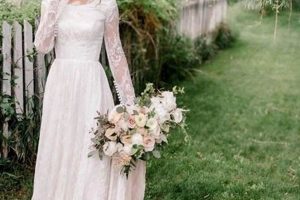
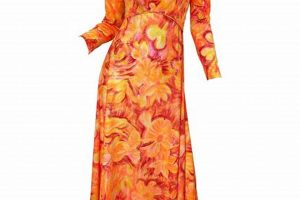
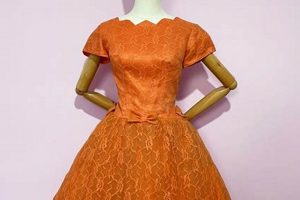
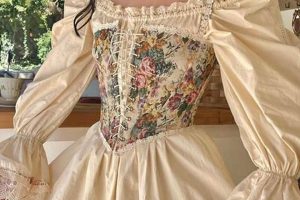
These serve as templates for replicating bridal gowns from past eras. They offer detailed instructions and scaled diagrams enabling the creation of garments reflecting specific historical styles, ranging from the flowing silhouettes of the 1920s to the structured designs of the 1950s. The utilization of appropriate fabrics and embellishments, guided by these templates, is crucial in achieving an authentic vintage aesthetic in the finished piece.
Their significance lies in providing access to styles often unavailable through contemporary retail outlets or cost-prohibitive as original vintage pieces. These resources empower individuals to craft custom, historically accurate wedding attire, allowing for personalized fit and fabric choices. Historically, dressmaking skills were common, and these paper guides facilitated home-based garment production. Today, they represent a connection to that past and offer a sustainable, creative alternative to mass-produced clothing.
The following discussion will delve into the factors to consider when selecting appropriate guides, understanding sizing conventions of different eras, and adapting instructions for modern fabrics and body types. Furthermore, the acquisition, preservation, and modification of these often fragile documents will be addressed, providing a comprehensive overview for aspiring vintage bridal gown creators.
Essential Guidance for Utilizing Bridal Gown Templates from Bygone Eras
Successfully employing historical bridal gown templates requires meticulous attention to detail and an understanding of the nuances inherent in working with patterns and fabrics of the past.
Tip 1: Prioritize Accurate Measurements: Vintage templates often adhere to sizing standards that differ significantly from contemporary norms. Accurate body measurements are paramount. Compare these measurements meticulously with the pattern’s size chart and adjust accordingly before cutting any fabric.
Tip 2: Source Appropriate Fabrics: The selection of materials that closely resemble those used in the original design is crucial for achieving an authentic aesthetic. Research fabric types common during the era represented by the template, considering weight, drape, and texture. Silk, satin, lace, and organdy were frequently used in vintage bridal wear.
Tip 3: Create a Muslin Mock-Up: Before cutting into the final fabric, construct a muslin mock-up. This allows for adjustments to fit, alterations to the design, and practice in working with the pattern pieces. It also provides an opportunity to assess the overall silhouette and drape of the gown.
Tip 4: Understand Seam Allowances: Vintage templates may have varying or even unmarked seam allowances. Identify and consistently apply the correct seam allowance throughout the project to ensure accurate construction and prevent size discrepancies.
Tip 5: Reinforce Delicate Fabrics: Many vintage templates call for delicate fabrics prone to fraying or tearing. Interfacing or lining should be used to reinforce these areas, adding stability and extending the garment’s lifespan. Consider using appropriate underlining techniques to enhance structure and prevent show-through.
Tip 6: Master Vintage Sewing Techniques: Techniques like hand-picking zippers, French seams, and rolled hems are frequently found in vintage garments. Research and practice these techniques to achieve a more authentic and durable finish.
Tip 7: Preserve the Original Pattern: Handle fragile patterns with care to avoid tearing or damage. Consider tracing the pattern pieces onto sturdier paper to preserve the original for future use. Store patterns in acid-free envelopes or boxes to protect them from deterioration.
These considerations, when diligently observed, contribute significantly to the successful creation of a bridal gown that embodies the elegance and craftsmanship of a bygone era. A commitment to accuracy and historical detail ensures a stunning and enduring heirloom.
The subsequent sections will provide further guidance on embellishments, alterations, and other advanced techniques related to working with these resources, leading to a greater mastery in the art of crafting vintage-inspired bridal attire.
1. Era Identification

Era identification forms the bedrock upon which the successful utilization of historical bridal gown templates rests. A clear understanding of the specific period a pattern represents directly influences fabric selection, construction techniques, silhouette, and ornamentation. Failure to accurately identify the era can result in a garment that is stylistically inconsistent and historically inaccurate. For example, attempting to create a 1930s bias-cut gown using a pattern incorrectly attributed to the Victorian era would result in a misrepresentation of both periods, due to fundamental differences in silhouette and construction methods. Thus, accurate era identification is paramount to achieving an authentic vintage aesthetic.
The importance of correct dating is further exemplified by the variations in sizing and construction techniques employed across different periods. Templates from the 1920s, for instance, often feature simpler construction methods and looser fits compared to the more structured designs of the 1950s. Furthermore, pattern companies themselves evolved, with different manufacturers possessing unique stylistic signatures and drafting methodologies. The presence of specific design details, pattern company logos, or even fabric recommendations printed on the pattern envelope can serve as crucial clues in accurately determining the template’s origin and intended style. Incorrectly attributing a pattern to the wrong era could lead to significant errors in fabric selection and construction, ultimately compromising the final garment’s historical accuracy.
In conclusion, accurate era identification is an indispensable initial step in utilizing bridal gown templates from bygone eras. This process requires careful analysis of design features, pattern markings, and historical context. Overlooking this fundamental step risks the creation of a garment that lacks historical integrity and fails to accurately represent the desired aesthetic. Thorough research and attention to detail in era identification are essential for achieving successful and authentic vintage-inspired bridal attire.
2. Sizing Discrepancies

The challenges presented by sizing discrepancies are a critical consideration when utilizing bridal gown templates from prior eras. Variations in body ideals, measurement techniques, and pattern drafting practices across different periods necessitate careful attention to ensure a proper fit when recreating these garments.
- Evolving Body Ideals
Body standards have shifted significantly throughout history. For instance, a “standard” size 12 in the 1950s differs considerably from a modern size 12. Vintage templates often reflect these historical preferences for particular body shapes, such as a higher bust line or a smaller waist-to-hip ratio. This necessitates comparing individual measurements to the template’s size chart and adjusting accordingly, potentially requiring significant alterations to the pattern.
- Inconsistent Measurement Techniques
Methods of taking body measurements have also evolved. Earlier periods might have used different points of reference or relied on less precise measuring tools. The absence of standardized sizing charts further exacerbates this issue. A “bust” measurement, for example, might have been taken at a different point on the body or with a different degree of tension. This requires scrutinizing the template’s measurement guide and, if necessary, comparing it to contemporary measurement practices to ensure accuracy.
- Pattern Drafting Variations
Pattern drafting techniques themselves have undergone significant changes. Methods used to create templates have varied across different manufacturers and eras. Some patterns might have been drafted using flat patternmaking techniques, while others employed draping methods. These variations can lead to discrepancies in the finished garment’s fit and silhouette. A pattern drafted for a more structured fit may require adjustments to accommodate a more flowing or relaxed silhouette, depending on the desired outcome.
- Paper Degradation and Alteration
The physical condition of templates can also introduce inaccuracies. Vintage patterns, often printed on fragile paper, are susceptible to damage, shrinkage, or stretching over time. Previous owners may have made alterations to the pattern that are not clearly marked or documented, further complicating the process of achieving an accurate fit. Therefore, careful inspection of the physical template and comparison with known measurements is crucial before commencing any cutting or sewing.
Addressing sizing discrepancies in bridal gown templates from previous eras is a multifaceted undertaking. It demands a nuanced understanding of historical body ideals, measurement methodologies, and pattern drafting techniques. Successful adaptation requires meticulous attention to detail, accurate measurements, and a willingness to make significant alterations to the template. These considerations are paramount to achieving a well-fitting and historically accurate reproduction.
3. Fabric Authenticity

The successful execution of bridal gowns from historical templates is significantly contingent upon the selection of materials that closely align with those employed in the original designs. Fabric authenticity extends beyond mere visual similarity, encompassing factors such as fiber content, weave structure, weight, drape, and surface texture. Disregarding these elements can compromise the historical accuracy and overall aesthetic integrity of the finished garment.
- Fiber Content and Historical Availability
The fiber content of fabrics varied considerably across different eras. Synthetics, such as polyester, were non-existent before the mid-20th century. Reliance on natural fibers like silk, cotton, linen, and wool was the norm. Using a modern synthetic in a design intended for a 1920s gown would be historically inaccurate. For instance, replicating a flapper-era dress requires silk charmeuse or rayon crepe rather than a modern polyester satin.
- Weave Structure and Drape Characteristics
Different weave structures impart unique drape characteristics to fabrics. A heavy, tightly woven satin from the 1950s will drape differently than a lightweight silk chiffon from the 1930s. Replicating a design requires understanding the intended drape and selecting a weave that approximates that quality. Using a stiff, modern brocade for a design requiring a fluid drape would result in an unsuitable garment.
- Weight and Dimensional Stability
The weight of a fabric significantly impacts its suitability for specific pattern designs. A heavy, closely woven fabric may be appropriate for a structured bodice but unsuitable for a flowing skirt. Similarly, dimensional stability, the fabric’s ability to maintain its shape, is crucial. Unstable fabrics can stretch or distort during construction, compromising the garment’s fit and appearance. Careful consideration of weight and stability is therefore crucial.
- Surface Texture and Visual Accuracy
Surface texture contributes to the overall visual accuracy of the replica. Details such as the luster of satin, the matte finish of crepe, or the delicate texture of lace contribute significantly to the garment’s aesthetic. Selecting fabrics with appropriate surface characteristics is essential. For example, using a highly textured brocade in place of a smooth satin would significantly alter the character of a design.
These considerations underscore the significance of meticulous fabric selection in the pursuit of accurately recreating bridal gowns from past eras. Adherence to the historical context, combined with a thorough understanding of fabric properties, will contribute to a higher degree of fidelity in the finished piece, honoring both the original design and the craftsmanship of the period it represents. The interplay between pattern design and material selection is central to the success of vintage-inspired bridal wear projects.
4. Construction Nuances

The successful translation of a vintage bridal gown template into a tangible garment hinges critically on understanding and implementing period-specific construction nuances. These subtleties in technique, often undocumented in contemporary pattern instructions, represent the difference between a modern reproduction and a garment that authentically reflects the era it seeks to emulate. The templates themselves provide only a skeletal framework; mastery of these nuances breathes life into the design.
The cause-and-effect relationship between construction nuances and the final product is direct and demonstrable. For instance, the application of couture techniques, such as hand-basted seams and meticulously understitched facings, common in mid-20th-century designs, results in a superior fit and a more refined silhouette compared to mass-production sewing methods. Omitting these details, even while adhering to the pattern’s basic outline, leads to a garment that lacks the precision and inherent structure characteristic of vintage couture. Similarly, the use of specific interfacing materials, dictated by historical availability and aesthetic considerations, directly impacts the fabric’s drape and the garment’s overall shape. Modern interfacings, even when superficially similar, may produce an undesired stiffness or bulkiness, detracting from the authenticity of the replica. The construction sequence, often implied rather than explicitly stated in vintage templates, is also crucial. The order in which elements are assembled influences the way seams lie, the distribution of weight, and the overall structural integrity of the gown. A misconstrued construction sequence can lead to distortions in the fabric and a compromised fit.
In conclusion, the mastery of construction nuances is not merely an optional refinement but a fundamental requirement for successfully realizing a bridal gown from a historical template. Understanding these subtleties, from the type of stitching to the order of assembly, is essential for achieving a finished garment that accurately reflects the aesthetic and technical standards of its era. Overlooking these details risks creating a distorted or inauthentic representation, highlighting the critical connection between construction nuance and the accurate interpretation of vintage sewing patterns.
5. Embellishment Details
The selection and application of embellishments are integral components in recreating bridal gowns using sewing patterns for vintage wedding dresses. These details are not merely decorative add-ons; they define the character and historical accuracy of the finished garment, providing crucial visual cues to its era of origin.
- Beadwork and Sequins
Beadwork and sequins played a significant role in embellishing wedding gowns from the early to mid-20th century. The type, size, and application method of these elements are era-specific. For example, intricate glass beadwork characterized gowns of the 1920s, while larger sequins and plastic beads became more prevalent in later decades. Accurate replication requires sourcing materials similar to those originally used and employing appropriate attachment techniques, such as hand-sewing rather than machine application.
- Lace Application
Lace, in its various forms, served as a primary embellishment across numerous eras. The type of lace (e.g., Alenon, Chantilly, point d’esprit) and its application (e.g., appliqu, edging, insertion) are critical factors. Vintage patterns may specify the use of particular lace types, which must be sourced or accurately replicated to maintain historical consistency. The method of attaching lace, whether by hand or machine, and the treatment of lace edges (e.g., picot edging, scalloped trim) further contribute to the overall aesthetic.
- Embroidery Techniques
Embroidery, encompassing techniques like satin stitch, French knots, and bullion work, was commonly used to add intricate details to bridal gowns. The style and motifs of the embroidery are indicative of the era. For instance, floral embroidery was prevalent in the Victorian era, while geometric patterns were more common in Art Deco designs. Replicating embroidery accurately requires mastering the necessary stitching techniques and selecting threads that match the color and texture of those originally used.
- Ribbons and Trims
Ribbons and trims, including velvet ribbons, silk sashes, and decorative braids, provided additional embellishment options. The width, material, and color of these trims are essential considerations. Patterns often specified the use of particular ribbons or trims to define the waistline, neckline, or hem. Sourcing these materials or creating accurate reproductions contributes significantly to the overall accuracy and visual impact of the completed garment.
These embellishment details, when faithfully executed, elevate a garment constructed from a sewing pattern for vintage wedding dresses from a mere reproduction to a compelling embodiment of a specific historical period. They are the visual language through which the character and elegance of bygone eras are conveyed.
6. Preservation Methods

The longevity and usability of sewing patterns for vintage wedding dresses are directly contingent upon the preservation methods employed. These templates, often printed on fragile paper, are vulnerable to deterioration caused by environmental factors, handling, and inherent material instability. Proper preservation ensures that these invaluable resources remain accessible for future generations of designers and historians.
- Acid-Free Storage
The primary component of preserving paper-based materials is utilizing acid-free storage solutions. Acid migration from paper fibers and surrounding materials leads to embrittlement and discoloration. Enclosing patterns in acid-free envelopes, folders, or archival boxes prevents or slows this process. Real-world examples include museums and historical societies housing pattern collections within climate-controlled, acid-free environments. The implication for bridal gown templates is a significantly extended lifespan, allowing for repeated use and study.
- Climate Control
Environmental factors, particularly temperature and humidity, significantly impact paper degradation. Fluctuations in these conditions cause expansion and contraction, leading to tears and distortions. Maintaining a stable, cool, and dry environment is crucial. Libraries and archives commonly employ climate control systems to mitigate these risks. For individual owners, storing patterns away from direct sunlight, heat sources, and areas with high humidity, such as bathrooms or basements, is recommended. This reduces the rate of deterioration, preserving pattern integrity over time.
- Careful Handling
Physical handling of patterns contributes to wear and tear. Creases, tears, and losses are common results of improper handling. Implementing careful handling protocols, such as using clean hands, avoiding excessive folding or bending, and providing adequate support when unfolding large pattern pieces, minimizes damage. Museum curators often wear gloves when handling delicate artifacts. For bridal gown templates, this translates to increased lifespan and legibility, particularly for heavily used pattern pieces.
- Digitization and Reproduction
Digitization offers a non-destructive method for preserving pattern information. Scanning or photographing patterns allows for creating digital copies that can be used for pattern manipulation and reproduction without risking damage to the original. Many online archives offer digitized pattern collections. For sewing patterns for vintage wedding dresses, this provides a means to create working copies, preserving the original pattern for archival purposes. Digitization also facilitates sharing and collaboration among researchers and designers.
The integration of these preservation methods ensures the continued availability and usability of sewing patterns for vintage wedding dresses. By mitigating the detrimental effects of environmental factors and handling, these strategies allow for accurate replication and historical study of bridal gown designs from past eras. Neglecting these practices results in the gradual loss of these valuable cultural artifacts, limiting future access to historical design information.
Frequently Asked Questions
This section addresses common inquiries regarding the utilization of vintage bridal gown templates, offering guidance and clarification on prevalent areas of concern.
Question 1: How does one determine the correct size when using vintage patterns, given that sizing standards have changed significantly over time?
Accurate measurements are paramount. Compare individual body measurements to the pattern’s size chart, ignoring the numerical size designation. Allow for ease of movement and potential alterations. Consider creating a muslin mock-up to assess fit before cutting into the final fabric. Consult resources on vintage sizing for additional guidance.
Question 2: Where can authentic sewing patterns for vintage wedding dresses be reliably sourced?
Reputable sources include online vintage pattern retailers, antique stores, estate sales, and specialized pattern archives. Exercise caution when purchasing from unverified sources to avoid reproductions misrepresented as originals. Examine pattern packaging and markings to verify authenticity.
Question 3: What are the key differences between modern and vintage sewing techniques, and why are these differences important?
Vintage sewing techniques often involved hand-sewing, intricate seam finishes, and specific methods for interfacing and lining. These techniques were employed to enhance durability and create a refined silhouette. Understanding and implementing these techniques contributes to a more authentic and historically accurate garment.
Question 4: How can fragile vintage patterns be handled and preserved to prevent damage?
Handle patterns with clean, dry hands. Avoid excessive folding or bending. Store patterns in acid-free envelopes or archival boxes away from direct sunlight and moisture. Consider digitizing patterns to create working copies and minimize handling of the original.
Question 5: What types of fabrics are most suitable for recreating vintage wedding gowns, and where can they be sourced?
Suitable fabrics depend on the era of the pattern, but generally include silk charmeuse, rayon crepe, satin, and lace. Source fabrics from reputable fabric stores specializing in bridal or historical materials. Consider using vintage or vintage-inspired fabrics for enhanced authenticity.
Question 6: How are alterations best approached when working with a vintage bridal gown template to achieve a contemporary fit?
Make alterations to a muslin mock-up before cutting into the final fabric. Adjust pattern pieces to accommodate individual body measurements, paying attention to bust, waist, and hip circumferences. Consider seeking assistance from a skilled seamstress with experience in vintage pattern alterations.
In summary, the successful utilization of patterns of this type requires a blend of historical knowledge, sewing expertise, and meticulous attention to detail. Careful planning, accurate execution, and a commitment to preservation contribute to a rewarding and historically informed sewing experience.
The following section will address advanced techniques and considerations for customizing vintage bridal gown designs, offering insights into pattern manipulation and stylistic adaptation.
sewing patterns for vintage wedding dresses
This exploration has illuminated the critical considerations involved in working with bridal gown templates from previous eras. These encompass accurate era identification, addressing sizing discrepancies, ensuring fabric authenticity, mastering period-specific construction techniques, and understanding the nuances of embellishment. Furthermore, the importance of proper pattern preservation has been underscored. A comprehensive understanding of these factors is essential for achieving historically accurate and aesthetically pleasing results.
The diligent application of these principles enables the creation of enduring bridal garments that honor the craftsmanship and design sensibilities of bygone eras. Further research and continued skill development will enhance the ability to accurately interpret and recreate these historical treasures. This pursuit contributes to the preservation of sartorial history and fosters a deeper appreciation for the artistry inherent in vintage bridal wear.