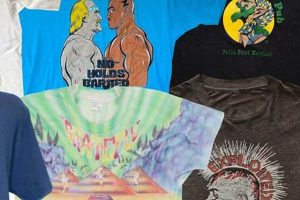
Apparel featuring the Coors Brewing Company logo, produced in previous decades, constitutes a segment of vintage clothing. These items, typically t-shirts, represent a tangible connection to the brand’s advertising history and the broader cultural landscape of their respective eras. For example, a crew-neck garment displaying a 1970s-era Coors Banquet logo, screen-printed on a single-stitch fabric, would fall under this classification.
The appeal of these garments resides in their representation of a bygone era and the cultural associations linked to the Coors brand. These associations might encompass perceptions of Americana, outdoor recreation, or specific advertising campaigns. Their value stems from factors such as rarity, design, condition, and the historical significance of the logo or artwork featured. This collectible status contributes to their desirability among enthusiasts of vintage clothing and collectors of breweriana.
Understanding the factors contributing to the value and collectibility of these items requires examining key areas such as historical advertising campaigns, manufacturing processes of vintage apparel, methods for authenticating vintage garments, and the current market trends influencing their desirability. Further discussion will delve into these aspects to provide a comprehensive overview.
Acquiring or assessing the value of apparel related to the Coors Brewing Company requires careful consideration. The following guidelines offer assistance in navigating this specific area of vintage collecting.
Tip 1: Examine the Stitching: Single-stitch construction, common in shirts produced before the 1990s, can be an indicator of age. However, this is not definitive, as some modern reproductions may mimic this style.
Tip 2: Evaluate the Graphic Quality: Original graphics typically display some degree of fading or cracking consistent with age and wear. Pristine graphics on an alleged vintage piece warrant closer inspection.
Tip 3: Research the Logo: Coors employed various logos and designs throughout its history. Familiarity with these designs allows for assessment of the shirt’s potential era of production.
Tip 4: Inspect the Tag: While tags can be removed or replicated, an original tag provides valuable information. Research common tag styles used by apparel manufacturers during specific periods.
Tip 5: Assess Condition Carefully: While some wear is expected in vintage items, significant damage, stains, or alterations can drastically reduce value.
Tip 6: Consider Rarity: Limited-edition designs or those associated with specific events or promotions command higher prices due to their scarcity.
Tip 7: Compare Prices: Before making a purchase, research similar items on online marketplaces and auction sites to establish a fair market value.
These considerations aid in assessing the authenticity and potential value of vintage apparel associated with the Coors Brewing Company. Proper evaluation necessitates thorough research and careful examination.
These insights will be further applied as we move towards concluding remarks.
1. Era of Production

The Era of Production is paramount in determining the value, authenticity, and collectibility of vintage apparel bearing the Coors Brewing Company branding. The manufacturing techniques, design aesthetics, and licensing practices specific to a given period significantly influence the characteristics of the garment.
- Fabric Composition and Availability
The types of fabrics used in clothing manufacture varied considerably across different eras. Early Coors apparel may feature 100% cotton, while later decades saw the introduction of polyester blends. The availability and common use of specific materials serve as indicators of a shirt’s potential age. For example, a shirt utilizing a specific blend of polyester and cotton, common in the 1970s, provides a clue regarding its production timeframe.
- Screen Printing Techniques
The methods used for applying graphics to apparel have evolved over time. Early screen printing processes often resulted in thicker, more textured prints compared to modern techniques. Identifying these nuances can help to date a garment. A vintage shirt showcasing a slightly raised, heavily inked graphic, characteristic of older screen printing methods, supports its classification as a product of a specific era.
- Tagging Conventions
Apparel manufacturers employed distinct tagging styles throughout the decades. Researching the tagging conventions of prominent clothing brands during different periods offers insight into when a garment was produced. An examination of the tag on a Coors branded t-shirt can potentially link it to a specific manufacturer and timeframe based on its design, material, and included information.
- Licensing Agreements
Coors Brewing Company’s licensing agreements with apparel manufacturers changed over time. The presence of specific licensing marks or the absence thereof can offer clues about the garment’s origin. A shirt bearing a specific trademark designation or copyright notice linked to a known licensing agreement indicates a particular production window.
These facets of the Era of Production, when considered collectively, contribute significantly to accurately assessing the history and value of vintage Coors branded apparel. The interplay between fabric technology, printing methods, tagging practices, and licensing arrangements creates a multifaceted framework for determining the origins of these collectible items.
2. Graphic Authenticity

Graphic authenticity is a critical determinant in evaluating apparel featuring the Coors Brewing Company logo. It directly impacts the value and collectibility of garments marketed as “vintage.” The graphic design, printing technique, and overall condition serve as indicators of a garment’s age and originality. Inauthentic graphics, whether deliberate reproductions or unintentional misrepresentations, diminish value and misrepresent the item’s historical context.
The authenticity of a graphic often hinges on details such as the specific font used, the accuracy of the Coors logo for a particular era, and the printing method employed. For example, a design employing a font not in use during the purported manufacturing period is a strong indicator of inauthenticity. Examination under magnification may reveal inconsistencies in the printing process, such as digital printing techniques applied to a garment claiming pre-digital production. Further, comparison against documented Coors advertising campaigns or licensed merchandise from the claimed era can validate or invalidate the graphic’s legitimacy.
Accurate assessment of graphic authenticity presents challenges due to the prevalence of reproductions and the aging of original designs. However, understanding the historical context of Coors’ branding, printing techniques, and licensing agreements allows collectors and sellers to better evaluate garments. Thorough inspection and verification are essential to ensure accurate representation and prevent the devaluation of genuine pieces due to misidentification or deceptive practices, which ultimately protects the integrity of the vintage market.
3. Fabric Composition
Fabric composition serves as a key indicator of a garment’s age and authenticity, particularly when evaluating apparel connected to the Coors Brewing Company. The materials used in clothing production have evolved significantly over time, creating a direct correlation between fabric type and the potential era of manufacture. For example, early examples of apparel bearing the Coors logo often utilized 100% cotton. As synthetic fibers became more prevalent, blends of cotton and polyester, or entirely synthetic fabrics, became commonplace. The presence of these specific material compositions offers insights into the potential timeframe of production, serving as a vital clue when assessing garments. Identifying fabric composition is essential in the process of determining what era a shirt come from and if the claim of being vintage is correct.
The understanding of fabric composition has practical significance in authentication and valuation. A supposed “vintage” garment constructed entirely of modern synthetic materials would be immediately suspect. Similarly, the thread count, weave, and texture of the fabric contribute to its overall character. Original garments often possess a distinct feel and drape that cannot be easily replicated with contemporary materials. The ability to distinguish between different fabric types and their characteristics empowers collectors and resellers to differentiate authentic pieces from reproductions. Consider a situation where two garments feature similar graphics; one constructed of a thin, modern cotton-polyester blend and the other a heavier, coarser 100% cotton. The latter may signal a garment that is potentially vintage
While fabric composition alone is not a definitive marker of authenticity, it provides essential contextual information. Determining authenticity of a “vintage coors shirt” involves several steps: checking tags, the fabric, print style and other factors which can make the assessment more challenging. Recognizing the significance of fabric composition is an important aspect when evaluating vintage pieces and contributes to a greater understanding of apparel as historical artifacts.
4. Stitch Construction
Stitch construction serves as a significant indicator in assessing the authenticity and age of apparel, particularly in evaluating vintage garments bearing the Coors Brewing Company logo. Garment manufacturing techniques, including stitching methods, have evolved over time. Recognizing these changes allows for informed judgment regarding a garment’s potential era of production. Single-stitch construction, where a single line of stitching secures the hem of a shirt, was commonly used in apparel manufacturing prior to the 1990s. The presence of single-stitch construction on a t-shirt displaying a Coors logo can suggest a manufacturing date before this period. Conversely, double-stitched hems, where two parallel lines of stitching are present, are characteristic of more modern manufacturing practices.
The practical significance of understanding stitch construction lies in its ability to differentiate between genuine vintage apparel and modern reproductions. While some manufacturers may attempt to replicate the appearance of vintage garments, they often overlook the nuances of stitch construction. For example, a newly produced shirt utilizing modern fabrics and printing techniques but attempting to emulate a vintage Coors design is less likely to accurately reproduce single-stitch construction. Examination of the hem reveals the modern double-stitch, exposing the garment as a reproduction. Furthermore, stitch density and thread type also vary between eras. Vintage garments often exhibit a lower stitch density and the use of natural fiber threads, while modern garments typically employ higher stitch density and synthetic threads.
In summary, the presence or absence of single-stitch construction, combined with other factors such as fabric composition, graphic design, and tagging, contributes to a comprehensive assessment of a Coors branded garment’s vintage status. While stitch construction alone does not guarantee authenticity, its consideration is crucial in differentiating between genuine vintage apparel and modern imitations, especially when the garments are being purchased or sold as collectibles. Attention to such details, when determining a vintage Coors shirt, help ensure a more accurate assessment.
5. Brand Licensing
Brand licensing plays a pivotal role in the realm of apparel featuring the Coors Brewing Company logo. Its impact extends from determining a garment’s authenticity and era of production to influencing its collectibility and market value. Understanding the nuances of licensing agreements is crucial for accurately evaluating these garments, especially when classifying them as “vintage.”
- Licensing Marks and Copyright Notices
The presence or absence of specific licensing marks and copyright notices serves as a primary indicator of a garment’s origin and potential authenticity. Officially licensed merchandise typically displays trademarks, copyright symbols, and the name of the licensee. The absence of these marks on a garment claiming to be officially licensed raises suspicion. For example, a t-shirt displaying the Coors logo but lacking a trademark symbol or copyright notice from the apparel manufacturer might suggest unauthorized production. Variations in these marks over time further assist in dating the garment.
- Exclusive Agreements and Limited Editions
The Coors Brewing Company may have entered into exclusive licensing agreements with specific apparel manufacturers for particular product lines or limited-edition designs. Garments produced under such agreements often possess higher collectibility due to their scarcity. Understanding these exclusive partnerships is crucial for identifying potentially valuable items. If a vintage Coors shirt bears a logo for a specific sporting event or promotion and is tied to a particular apparel manufacturer via licensing records, it reinforces its authenticity and potentially increases its desirability among collectors.
- Promotional Items vs. Retail Products
Brand licensing distinguishes between apparel intended for promotional purposes and those sold through retail channels. Promotional items, often distributed as part of marketing campaigns or employee uniforms, may feature designs or materials distinct from retail products. The licensing agreements governing these two categories may differ significantly. Distinguishing between promotional and retail Coors shirts provides insights into their intended purpose and relative rarity. A shirt given away at a Coors-sponsored event, for instance, might be less common than a similar design sold in department stores.
- Geographic Licensing Restrictions
Licensing agreements can be geographically restricted, meaning that certain manufacturers are only authorized to produce and distribute Coors branded apparel within specific regions. Understanding these restrictions assists in determining a garment’s origin based on its labeling and manufacturing details. A Coors shirt bearing a label indicating production in a country outside the scope of known licensing agreements raises questions about its authenticity or potentially indicates unauthorized distribution. This can affect its value in particular markets or its collectibility overall.
The intricate relationship between brand licensing and apparel displaying the Coors Brewing Company logo impacts every stage of its life cycle, from initial production and distribution to its eventual status as a collectible vintage item. Evaluating these elements helps to correctly authenticate an item, and place its value.
Frequently Asked Questions
The following questions address common inquiries regarding vintage garments featuring the Coors Brewing Company branding. These answers aim to provide clarity and informed perspectives on this specific area of vintage apparel.
Question 1: What constitutes a “vintage” garment in the context of apparel displaying the Coors logo?
Generally, a garment is considered vintage if it is at least 20-25 years old. In the context of shirts displaying the Coors logo, this would typically refer to apparel produced before the late 1990s or early 2000s. Other criteria, such as manufacturing techniques and design styles, also contribute to its classification as vintage.
Question 2: How can the authenticity of a purported “vintage” shirt bearing the Coors logo be verified?
Verification involves a multi-faceted approach. Examination of the stitch construction (e.g., single-stitch versus double-stitch), fabric composition, graphic design, and tagging are crucial. Comparing the garment’s characteristics to documented Coors branding and apparel manufacturing practices of specific eras is also recommended.
Question 3: What factors contribute to the market value of a “vintage” Coors shirt?
Market value is influenced by several factors, including rarity, condition, design, historical significance, and demand among collectors. Limited-edition designs, shirts associated with specific events or promotions, and those in excellent condition typically command higher prices.
Question 4: Are reproductions or modern imitations of “vintage” Coors shirts prevalent?
Yes, reproductions and modern imitations are common. These items often attempt to replicate the appearance of vintage garments but may lack the authentic details and manufacturing techniques of the originals. Careful inspection is crucial to distinguish between genuine vintage items and reproductions.
Question 5: Where can authentic “vintage” Coors shirts be sourced?
Potential sources include vintage clothing stores, online marketplaces specializing in vintage apparel, estate sales, and auctions. However, due diligence is essential when purchasing from any source to ensure the authenticity of the garment.
Question 6: What are the potential risks associated with purchasing “vintage” Coors shirts online?
Purchasing online carries risks, including misrepresentation of the garment’s condition, inaccurate descriptions of its authenticity, and the potential for receiving a reproduction instead of a genuine vintage item. Reviewing seller ratings and requesting detailed photos before purchasing are recommended.
In summary, determining the authenticity, value, and origin of these garments necessitates a careful assessment of several factors. Buyers and sellers should remain diligent in their evaluations to ensure accurate representation and fair market practices.
The upcoming section will explore preservation techniques to maintain the condition of these collectible pieces.
Conclusion
The investigation into apparel featuring the Coors Brewing Company logo has revealed the complexities inherent in evaluating items classified as “vintage coors shirt.” Key determinants include era of production, graphic authenticity, fabric composition, stitch construction, and brand licensing. Rigorous assessment of these factors is paramount in differentiating authentic vintage garments from modern reproductions.
As interest in vintage apparel continues, careful consideration must be given to authentication practices and market transparency. The preservation of these garments as cultural artifacts depends on informed evaluation and responsible stewardship, ensuring their accurate representation for future collectors and enthusiasts.