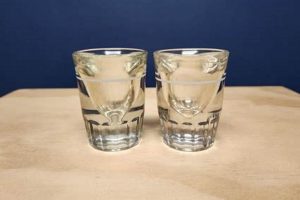
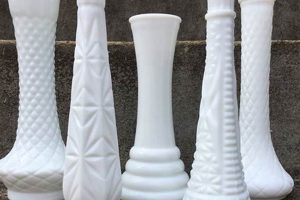
A decorative item originating from a prior era, crafted from colored material, and shaped to hold contents. These pieces represent a specific aesthetic from their time of manufacture, often showcasing unique artistic styles and manufacturing techniques no longer commonly employed.
Acquisition of these items provides a tangible connection to the past, offering insights into design trends and craftsmanship of previous generations. Such artifacts can serve as focal points in interior design, adding character and historical depth to a space. Further, given their age and potential rarity, these objects can appreciate in value, becoming assets over time.
The subsequent sections will delve into the specifics of identifying authentic examples, assessing their condition, and understanding their potential market value. Examination of design characteristics and manufacturing processes will be included, along with guidance on responsible collecting and preservation.
The pursuit of acquiring authentic, period-specific colored glassware requires diligence and informed decision-making. The following points offer guidance in identifying, assessing, and maintaining these historical items.
Tip 1: Authenticate Color Composition: Verify that the color is inherent to the glass itself, not a surface treatment. Surface treatments can degrade or be later additions, reducing value and historical accuracy. Examination under magnification may reveal inconsistencies or applied layers.
Tip 2: Assess for Manufacturing Imperfections: Examine for bubbles, striations, or asymmetry consistent with period-appropriate manufacturing techniques. Machine-made glass, typically post-1920s, will exhibit greater uniformity and fewer imperfections than hand-blown examples.
Tip 3: Identify Maker’s Marks: Research any maker’s marks or signatures present. These marks can provide critical information regarding the origin, date, and potential value of the piece. Reputable sources for identifying maker’s marks include historical catalogs and collector’s guides.
Tip 4: Evaluate Condition Critically: Assess the item for chips, cracks, scratches, or repairs. The presence of damage significantly impacts value, particularly for rarer or more desirable pieces. Professional restoration may be considered, but should be carefully documented.
Tip 5: Research Market Value: Investigate recent sales of comparable items to establish a fair market value. Auction records and price guides offer valuable insights into current collector demand and pricing trends. Consider condition, rarity, and provenance when assessing value.
Tip 6: Consider Provenance: Investigate the history of the object, if possible. Provenance can significantly impact the piece’s value and historical significance. Any documentation linking the item to a notable owner or event should be carefully preserved.
Tip 7: Handle with Care: Practice gentle handling techniques to minimize risk of damage. Always lift from the base and support delicate features when cleaning or moving the object. Avoid abrasive cleaners and excessive pressure.
Adhering to these recommendations provides a framework for the informed collection and responsible preservation of these collectible items. Careful attention to detail and a commitment to research are paramount to ensuring their long-term value and historical integrity.
The subsequent section offers methods for cleaning and storing these pieces, ensuring their condition for future enjoyment and potential appreciation.
1. Color Saturation Variation

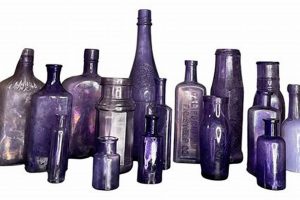
Within the context of antique amethyst or violet-hued glassware, variations in color saturation constitute a defining characteristic indicative of age, manufacturing processes, and material composition. This phenomenon arises from differing concentrations of colorants, primarily manganese oxide, added during glass production. Higher concentrations produce deeper, more intense colors, while lower concentrations result in paler shades. Sunlight exposure over prolonged periods can induce a color shift due to manganese oxidation, a process known as solarization, further contributing to saturation variation. The presence of differing saturation levels within a collection can reflect the diverse origins and histories of individual pieces. For example, a piece manufactured during wartime may exhibit lower color saturation due to material scarcity compared to a postwar example.
The practical significance of understanding color saturation variations lies in its application to authentication and valuation. Authentic older pieces may exhibit subtle variations due to inconsistent mixing or oxidation processes not replicated in modern reproductions. Intense, uniform saturation can be a red flag, suggesting a newer item colored with synthetic pigments. Auction houses and collectors frequently use saturation analysis, alongside other factors, to establish the age and authenticity of vintage glass. Furthermore, saturation contributes to the aesthetic value of the piece; collectors may seek out examples displaying unique or particularly striking color variations.
Consequently, color saturation variation in vintage purple glass objects forms a key diagnostic feature. It provides insights into manufacturing history, authenticity, and aesthetic merit. Challenges remain in quantifying saturation objectively and accounting for environmental factors. However, recognizing this property enhances the appreciation and informed acquisition of these collectable pieces.
2. Manufacturing era identification

The identification of the manufacturing era is critically intertwined with the valuation and authentication of these collectible items. The techniques, materials, and styles prevalent during specific periods directly influenced the appearance and characteristics of these objects. Consequently, understanding these historical contexts provides a crucial lens through which to assess authenticity and determine the piece’s significance. For instance, pressed glass production, which became widespread in the late 19th century, allowed for intricate designs at lower costs, leading to a proliferation of affordable glassware in various colors, including hues achievable through manganese additions. Recognizing the features associated with this manufacturing process, such as mold lines and repetitive patterns, assists in dating a specific piece and distinguishing it from hand-blown or later molded examples.
Conversely, the Art Deco period (1920s-1930s) saw the rise of streamlined designs and the use of different coloring agents, influencing the shade and intensity. Knowing the common motifs and color palettes employed during this era enables accurate categorization and evaluation. Further, the post-World War II period introduced new glassmaking technologies and synthetic colorants, often resulting in bolder, more consistent colors. Identifying these characteristics distinguishes pieces made during this time from earlier examples displaying more subtle and variable color tones. The absence of telltale signs from a given era suggests that the object may be a reproduction or a later creation that emulates earlier styles.
In summary, accurate determination of the manufacturing era forms an indispensable element in assessing the value, authenticity, and historical significance. The understanding ensures informed purchasing decisions, facilitates responsible collecting, and protects against acquiring misidentified or misrepresented items. The knowledge gained from this allows for better preservation practices, contributing to the longevity of the piece’s aesthetic and historical integrity for years.
3. Design style prevalence

The aesthetic attributes of any vintage object are inextricably linked to the prevailing design ethos of its manufacturing era. The color, form, and decorative elements present in a vintage amethyst-hued holding vessel are directly influenced by the stylistic trends dominant during its creation. This prevalence shapes not only the overall appearance but also the techniques and materials employed in its construction. For instance, if a piece dates from the Art Nouveau period, it will likely feature flowing, organic lines, perhaps with iridized surfaces to mimic the look of naturally occurring patinas, as evidenced in the works of designers like Louis Comfort Tiffany whose influence extended to various glassworks. Conversely, a Mid-Century Modern example might exhibit simpler, geometric forms, reflecting the minimalist aesthetic favored at that time. These stylistic markers provide valuable clues about the piece’s origin and contribute significantly to its desirability among collectors.
The understanding of design style prevalence enables informed authentication and valuation. Accurately identifying the stylistic period allows for comparison with known patterns and manufacturing techniques of that era. A piece purporting to be Art Deco but lacking the geometric symmetry and bold color contrasts characteristic of the style would raise concerns about its authenticity. Furthermore, the popularity and collectibility of specific styles fluctuate over time, influencing market value. Examples from highly sought-after periods, such as the Victorian era with its penchant for elaborate ornamentation, often command higher prices. This understanding also informs preservation efforts; appropriate cleaning methods and storage conditions are dependent on the materials and techniques used in creating the piece, ensuring the conservation of its original aesthetic qualities.
In conclusion, the design style that prevailed during an object’s creation serves as a critical identifier, offering insights into its origins, authenticity, and potential value. While stylistic influences can sometimes blur across periods, a thorough understanding of design history provides a valuable framework for evaluating and appreciating these vintage objects. The intersection between design trends and manufacturing techniques yields key insights into determining its age. Preserving the piece involves recognizing and maintaining the visual characteristics that define its historical and aesthetic importance.
4. Condition affecting valuation
The physical state of a purple glass bowl originating from a prior era significantly impacts its monetary value. Damage, such as chips, cracks, or extensive scratching, directly diminishes its worth. This is because condition fundamentally affects the object’s aesthetic appeal, structural integrity, and historical authenticity. A severely damaged object loses its capacity to accurately represent the craftsmanship and artistry of its period. For instance, a once vibrant bowl exhibiting significant discoloration due to prolonged sun exposure will command a lower price than a comparably rare piece retaining its original coloration. This is due to the inherent preference among collectors for items that closely resemble their original manufactured state.
Consider a scenario where two identical purple glass bowls from the 1920s are offered for sale. One is in pristine condition, exhibiting no visible flaws and retaining its original luster. The other, while retaining its color, exhibits several chips along its rim and noticeable surface scratches. The bowl in pristine condition will likely command a substantially higher price, possibly several times the value of the damaged bowl. The difference reflects the cost of restoration, the diminished display value, and the limited demand for imperfect items among serious collectors. Furthermore, the presence of repairs, while potentially restoring some functionality, often negatively impacts value unless performed by a highly skilled conservator, with meticulous documentation of the process.
In summation, the assessment of condition is a critical step in determining the valuation. Imperfections reduce an item’s appeal, authenticity, and potential longevity. By recognizing the correlation between structural integrity and market value, collectors and sellers can make more informed decisions, understanding the delicate balance between rarity, aesthetic appeal, and physical condition. This knowledge is crucial for both acquiring and preserving antique purple glass bowls, ensuring that these historical objects retain their value and significance for future generations. Therefore a careful inspection of the piece is needed.
5. Rarity within production

The scarcity of a particular “purple glass bowl vintage” within its original production run directly correlates to its contemporary market value and historical significance. Limited production can arise from various factors, including experimental coloration processes, short-lived design trends, or disruptions in manufacturing due to material shortages or economic downturns. The lower the number of units produced, the higher the potential demand and, consequently, the increased monetary worth. For instance, a specific shade of purple glass only briefly manufactured due to the instability of the coloring agent would become exceedingly rare, thus more valuable to collectors. Another cause could be the bowl might be a special edition to celebrate an important event or for a special occasion, limited pieces are produced on the occasion of this kind of event. These limited-edition quantities, therefore, lead to greater importance. Furthermore, examples exhibiting unique, unrepeated design elements or manufacturing flawswhile typically considered undesirablecan achieve premium prices precisely because of their singular nature.
The appreciation of this rarity necessitates a thorough understanding of glass manufacturing history and access to detailed production records, when available. Auction house catalogs, museum collections, and antique dealer inventories serve as invaluable resources for identifying items with documented limited production. Recognizing indicators of rarity, such as unique markings, atypical design features, or documented use of rare colorants, is essential for accurate assessment. For example, the bowl that features a combination of rare elements is a great addition. These include; an unusual shade of purple and experimental blowing with an uncommon design. This bowl would be highly desirable.
In conclusion, rarity as a key component significantly influences the value of any vintage glassware. This appreciation demands diligent research, keen observation, and an understanding of historical contexts. The challenge lies in accurately verifying production numbers and differentiating intentional design features from accidental flaws. Despite these challenges, discerning rarity remains crucial for collectors, appraisers, and historians seeking to understand the cultural and economic significance of these objects. This ensures responsible collecting and preservation of these pieces.
Frequently Asked Questions
The following addresses commonly encountered queries concerning the acquisition, authentication, and preservation of colored glass items from bygone eras.
Question 1: How can the authenticity of the coloration be verified?
The coloration should be integral to the glass matrix, not a surface application. Examination under magnification may reveal inconsistencies indicative of applied colorants. Period-appropriate pieces will often exhibit subtle color variations due to less precise mixing techniques.
Question 2: What impact do manufacturing imperfections have on the value?
Imperfections consistent with hand-blown or early manufacturing methods, such as bubbles or striations, can enhance value, confirming age and authenticity. However, significant structural flaws, such as cracks, substantially reduce value.
Question 3: How are maker’s marks located and interpreted?
Maker’s marks may be present on the base, side, or interior of the item. Reference reputable guides and online databases to identify the manufacturer and production dates associated with the mark.
Question 4: What constitutes appropriate cleaning and storage procedures?
Gentle handwashing with mild, pH-neutral detergents is recommended. Avoid abrasive cleaners or prolonged soaking. Store in a cool, dry location, away from direct sunlight, to prevent discoloration or degradation.
Question 5: How is fair market value determined for these items?
Research recent sales of comparable items through auction records and antique dealer listings. Condition, rarity, provenance, and aesthetic appeal all influence valuation. Consultation with a qualified appraiser is advisable for high-value pieces.
Question 6: What documentation enhances the provenance and value?
Original sales receipts, historical photographs, or written accounts linking the object to a notable owner or event significantly enhance its historical significance and market value. Preserve all such documentation meticulously.
Accurate authentication, meticulous preservation, and a realistic understanding of market dynamics are essential when engaging with these historical objects.
The next section details resources for further research and professional appraisal services.
Concluding Remarks on Objects of Colored Glass
The foregoing exploration has underscored the multifaceted attributes of these particular pieces. These decorative objects possess a complex interplay of historical significance, aesthetic appeal, and inherent market value. Factors such as color saturation variations, manufacturing era indicators, design style prevalence, condition assessment, and production rarity converge to define its worth and place within the realm of collectible glassware.
Continued research and diligent preservation efforts are paramount to ensuring the longevity and appreciation of these artifacts. Collectors and enthusiasts must approach the acquisition and stewardship with informed awareness, recognizing the responsibility in preserving cultural heritage for future generations. Thoughtful engagement with this historical glassware enriches the understanding of design evolution and material science.