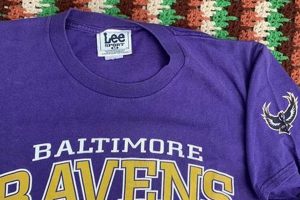
Apparel displaying the Chicago Bears logo and design elements from prior eras are highly sought after by collectors and fans. These garments often feature older team logos, specific player names and numbers from past seasons, or stylistic cues reflective of the decades in which they were originally produced. A common example includes t-shirts bearing the team’s iconic bear head logo as it appeared in the 1980s, screen-printed on a worn, single-stitch blank.
Possessing such memorabilia provides a tangible link to the team’s storied past, allowing supporters to connect with significant moments and legendary players. The appeal lies not only in demonstrating team allegiance but also in owning a unique piece of sports history, embodying the design aesthetics and cultural trends of a bygone time. They represent an era when the game was different and the team held a distinct place in the city’s identity.
Given the continued popularity, this specific type of clothing often appears in various online marketplaces, vintage clothing stores, and at sporting events. This popularity fuels a secondary market and presents opportunities for both casual enthusiasts and serious collectors to acquire these items. Understanding the nuances of these specific garments is essential for accurately identifying authenticity and value.
Acquiring Authentic Chicago Bears Vintage Apparel
The acquisition of authentic Chicago Bears apparel from previous decades requires careful consideration to ensure that the item is genuine and accurately represents its historical period. This section provides guidelines for verifying and evaluating potential purchases.
Tip 1: Examine the Logo and Design Details: Compare the logo against known historical versions. Minor variations in font, bear depiction, or color schemes can indicate reproductions. Reference official team publications and archived images to verify accuracy.
Tip 2: Assess the Fabric and Construction: Original garments from the 1970s and 1980s often used different fabrics and stitching techniques than modern apparel. Single-stitch seams are common in older t-shirts, while more modern apparel uses double-stitched seams. Fabric weight and texture also differ noticeably.
Tip 3: Evaluate the Tagging and Label Information: Inspect the tags for manufacturer details, sizing, and fabric content. Research the specific tagging styles used by prominent sportswear brands during the garment’s purported era. Inconsistencies can signal a replica.
Tip 4: Consider the Overall Condition and Wear: While some wear and tear is expected in vintage items, excessive damage or alterations may devalue the item or suggest a reproduction created to appear aged. Look for natural fading and wear patterns consistent with age.
Tip 5: Investigate the Source and Seller Reputation: Purchase from reputable vintage clothing dealers or established online marketplaces with buyer protection policies. Research the seller’s feedback and history to assess their trustworthiness.
Tip 6: Compare Pricing with Market Values: Research comparable items that have recently sold to understand the current market value. Prices that are significantly lower than average may indicate a counterfeit or misrepresented item.
Careful attention to these factors significantly increases the likelihood of acquiring a genuine Chicago Bears vintage shirt. Understanding the historical context, manufacturing practices, and telltale signs of authenticity enables informed decision-making.
By applying these techniques, both novice and experienced collectors can navigate the marketplace more effectively and confidently build a valuable collection of Chicago Bears memorabilia.
1. Authenticity

The determination of authenticity is paramount when evaluating apparel attributed to the Chicago Bears from prior decades. Establishing the genuine nature of a “chicago bears vintage shirt” dictates its value, historical significance, and desirability among collectors.
- Logo Verification
The team’s logos have evolved through various iterations. Discrepancies between the logo on the garment and documented historical logos raise concerns about legitimacy. Exact color matches, font styles, and placement relative to other design elements are critical markers. Reproductions often exhibit subtle, yet detectable, variations.
- Fabric and Construction Analysis
Materials and manufacturing techniques prevalent during specific eras serve as indicators of origin. For instance, single-stitch seams are characteristic of t-shirts produced before the late 1990s. A modern double-stitched garment bearing a vintage-style logo would suggest inauthenticity. Similarly, fabric blends and textures should align with those commonly used in the purported period of manufacture.
- Tag and Label Examination
Manufacturer tags provide valuable information, including brand, sizing, fabric content, and care instructions. Researching the tagging styles employed by prominent sportswear companies during the relevant timeframe is crucial. Incorrect fonts, misspelled words, or inconsistencies in branding can denote a counterfeit item. Absence of a tag on a garment that should have one is also a red flag.
- Provenance Research
Establishing the history of ownership provides corroborating evidence of authenticity. Documentation, such as original purchase receipts, photographs of the garment being worn in a historical context, or letters of provenance from reputable collectors, can enhance the credibility of an item. Conversely, a lack of verifiable history weakens its claim to genuineness.
These elements, when collectively assessed, allow for a more confident determination regarding the authenticity of any given piece of apparel. The value and historical significance hinges directly on its confirmed status as a genuine artifact from the Chicago Bears’ past.
2. Era Identification

Determining the specific era of origin is crucial when assessing Chicago Bears vintage shirts. Accurate identification allows for a more precise understanding of the garment’s historical context, design influences, and potential value. The following elements are central to establishing the period in which a particular shirt was produced.
- Logo Usage and Design Evolution
The Chicago Bears’ logo has undergone several revisions throughout its history. Identifying the specific logo iteration present on the shirt is a primary method for narrowing down its potential timeframe. Subtle changes in the bear’s depiction, font styles, and color palettes serve as chronological markers. For example, the “classic” bear head logo used from the 1970s through the 1990s differs significantly from earlier or later designs. Recognizing these nuances is essential.
- Tagging and Labeling Conventions
Sportswear manufacturers have employed distinct tagging and labeling practices during different eras. Examining the brand names, tag materials, font styles, and sizing conventions used on the garment provides valuable clues about its age. For instance, the presence of a specific union label, or the absence of a modern care instruction label, can indicate a pre-1980s production date. Knowledge of these manufacturer-specific details is beneficial.
- Fabric Composition and Construction Techniques
The types of fabrics used in apparel production have evolved over time. Vintage shirts often feature different blends and weights of cotton, polyester, or rayon compared to contemporary garments. Similarly, construction techniques, such as single-needle stitching versus double-needle stitching, can indicate the era of manufacture. A shirt constructed with a heavy cotton blend and single-needle seams is more likely to be from an earlier period than one made with a lightweight synthetic blend and double-needle seams.
- Sponsor and Event Markings
Shirts commemorating specific events, such as Super Bowl appearances or milestone anniversaries, offer a clear indication of their origin. The presence of sponsor logos or event-specific graphics provides definitive temporal markers. For example, a shirt bearing a Super Bowl XX logo can be confidently dated to the mid-1980s. Similarly, shirts celebrating the team’s founding or individual player achievements can be assigned to corresponding periods.
These facets collectively contribute to a more accurate era identification process. Understanding the interplay between logo evolution, tagging conventions, fabric composition, and the presence of event markings enables enthusiasts to assess the historical context of any Chicago Bears vintage shirt with greater precision, enhancing its value and significance as a collectible item.
3. Logo Variations

Logo variations are a critical determinant in evaluating Chicago Bears vintage shirts. The Chicago Bears, like many long-standing sports franchises, have employed multiple logo designs throughout their history. These variations, ranging from subtle alterations in font or color to complete redesigns of the team’s primary emblem, directly correlate to specific eras. Consequently, the logo featured on a vintage shirt provides a foundational clue to its age and potential authenticity. A shirt bearing a logo design inconsistent with a particular period raises immediate questions regarding its genuineness.
The historical record documents several distinct Chicago Bears logo iterations. For example, the minimalist “wishbone C” logo of the early years contrasts sharply with the more detailed bear head designs that gained prominence later. Identifying the specific features of the logo such as the shape of the bear’s snout, the presence or absence of specific details in the fur, or the font used for the team name allows for the shirt to be placed within a defined timeframe. The correct logo serves as a validating factor, whereas an anachronistic logo is indicative of a reproduction or a modern design incorporating vintage elements. Consider a shirt displaying the 1960s-era bear head logo, but utilizing a modern fabric blend; the logo might be authentic in design, but the composite elements would reveal its non-original nature.
Understanding the evolution of the Chicago Bears logo is essential for both collectors and casual enthusiasts seeking vintage apparel. This knowledge safeguards against misidentification and ensures that purchases accurately reflect the team’s historical legacy. The logo acts as a visual timestamp, connecting the shirt to a specific moment in the franchise’s history. Discrepancies in the logo therefore, impact not only the item’s value but also its credibility as a genuine piece of Chicago Bears memorabilia.
4. Fabric Composition
The composition of the fabric used in a Chicago Bears vintage shirt serves as a crucial indicator of its age, authenticity, and overall value. The materials and their construction provide insights into the manufacturing practices prevalent during different eras.
- Cotton Purity and Blends
Older shirts frequently feature higher percentages of pure cotton, often exhibiting a heavier weight and coarser texture compared to modern counterparts. The introduction of synthetic fibers like polyester and rayon into fabric blends became more widespread in later decades. Thus, identifying the specific cotton-synthetic ratio can help narrow down the production timeframe. A shirt labeled as “100% cotton” is potentially indicative of a pre-1980s garment, whereas a blend may suggest a later production period. The feel and drape of the fabric further corroborate these findings, as vintage cotton tends to soften and develop a distinct patina with age.
- Weave and Knit Patterns
The specific weave or knit pattern used in the fabric provides additional clues. Common patterns in older t-shirts include jersey knits, often characterized by their smooth face and slightly ribbed back. Changes in knitting technology led to variations in stitch density and texture over time. Examining the tightness of the knit and the presence of any distinct patterns can aid in identifying the shirt’s era. For example, a looser, more open knit might be associated with earlier production methods, while a tighter, more uniform knit may suggest a later period.
- Dyeing Techniques and Color Retention
The methods used to dye the fabric influence the shirt’s color retention and fading patterns. Older dyes often faded more readily, resulting in a softer, more muted color palette compared to the vibrant, long-lasting colors achieved with modern dyeing processes. Examining the degree of fading and the specific hues present can provide clues about the shirt’s age. Furthermore, the presence of specific dye variations or imperfections characteristic of certain eras can further refine the identification process. Uneven dyeing or subtle color shifts may be indicative of older techniques.
- Presence of Specific Fabric Treatments
The application of fabric treatments, such as pre-shrinking or wrinkle-resistant finishes, evolved over time. The presence or absence of these treatments can indicate the shirt’s era. For instance, a vintage shirt lacking a “pre-shrunk” label may be from an earlier period when this treatment was not yet standard practice. Similarly, the type of finish applied to the fabric can provide further insights. The presence of specific finishes, such as mercerization, can also provide insights into the manufacturing techniques used during that period.
Fabric composition is intertwined with the overall assessment of a Chicago Bears vintage shirt. It not only provides clues about its era but also influences its durability, comfort, and aesthetic appeal. The material’s characteristics, combined with logo variations, tagging styles, and construction details, enable a comprehensive evaluation of authenticity and historical significance.
5. Construction Details
Examination of construction details in Chicago Bears vintage shirts provides critical information regarding authenticity, era of production, and manufacturing practices. These seemingly minor features, when scrutinized, serve as reliable indicators of a garment’s origin and can differentiate between genuine articles and reproductions.
- Seam Construction
The type of seam construction employed is a significant factor. Single-stitch seams are prevalent in t-shirts produced prior to the late 1990s, while double-stitch seams are characteristic of more modern apparel. Single-stitch construction involves a single row of stitching along the seam, whereas double-stitch construction utilizes two parallel rows. Observing the seam construction along the sleeves, hem, and collar provides a primary indication of the garment’s era. The single-stitch is less durable than the double-stitch method and was gradually phased out with advancements in manufacturing.
- Collar Construction
Collar construction methods also evolved over time. Older shirts often feature a ribbed collar made of a thicker, more substantial material compared to contemporary collars. The method of attaching the collar to the body of the shirt can also provide clues. Some vintage shirts utilize a separate neckband that is sewn onto the collar, while others feature a seamless collar construction. Examining the stitching pattern and the type of material used in the collar provides additional data for era identification. For instance, the presence of a narrow, tightly ribbed collar made of a cotton-polyester blend may suggest a production date in the 1970s or 1980s.
- Sleeve and Hem Finishes
The finishing techniques applied to the sleeves and hem offer additional insights. Older shirts frequently feature a simple, folded hem secured with a single row of stitching. Modern shirts often employ a more elaborate, double-folded hem for added durability. The stitching pattern along the sleeve cuff can also vary. Some vintage shirts feature a raw edge or a minimally finished cuff, whereas modern shirts tend to have a more refined finish. The type of thread used and the stitch density further contribute to the overall aesthetic and provide clues about the garment’s origin.
- Tag Attachment Methods
The manner in which the manufacturer’s tag is attached to the shirt provides valuable information. Older tags are typically sewn into the collar or side seam using a simple straight stitch or a zigzag stitch. Modern tags often utilize more complex attachment methods, such as heat-sealing or multi-point stitching. The type of thread used to attach the tag and the tag’s placement can further aid in era identification. For instance, a tag sewn into the back of the collar with a single, straight stitch may suggest a production date in the 1960s or 1970s.
These construction details, when considered in conjunction with logo variations, fabric composition, and tagging styles, offer a holistic assessment of a Chicago Bears vintage shirt. A thorough examination of these elements increases the likelihood of accurately identifying the garment’s age and authenticity, thereby enhancing its value and historical significance.
6. Tagging Styles
Tagging styles present a crucial element in authenticating and dating Chicago Bears vintage shirts. The evolution of labeling practices among apparel manufacturers directly corresponds to specific eras. Consequently, examining the characteristics of a shirt’s tag offers significant clues regarding its age and potential legitimacy. These characteristics encompass the materials used for the tag, the font and layout of the printed information, and the manner in which the tag is affixed to the garment. Discrepancies between a tag’s features and the established tagging conventions of a particular period indicate a potential mismatch or a reproduction. For example, a t-shirt purported to be from the 1970s bearing a modern, digitally printed tag with a 21st-century brand logo would immediately raise concerns about its authenticity.
The importance of tagging styles extends beyond mere authentication. The information contained within the tag, such as the manufacturer’s name, size, fabric content, and care instructions, provides insights into the garment’s intended use and target market. A vintage shirt manufactured by a well-known sportswear brand popular during a specific era, such as Champion or Sand-Knit, adds to its collectibility and value. Conversely, a shirt lacking a tag, or bearing a tag from an unknown or obscure manufacturer, may be more difficult to authenticate and assess. Furthermore, the presence of a union label, prevalent in garments produced by unionized labor during certain periods, can offer additional confirmation of its age and origin. Practical application of this understanding involves cross-referencing tag information with established databases of vintage sportswear brands and tagging conventions.
In summary, tagging styles provide a valuable tool for evaluating Chicago Bears vintage shirts. Attention to detail in tag materials, printing, and attachment methods enables more accurate dating and authentication. Challenges remain in definitively identifying tags due to the wide range of manufacturers and variations in labeling practices over time. However, integrating tagging style analysis with other evaluation criteria, such as logo variations and fabric composition, helps to maximize the accuracy of the authentication process and ensures appreciation for the historical context of each garment.
7. Market Value
The market value of Chicago Bears vintage shirts is directly influenced by a confluence of factors, primarily authenticity, condition, rarity, and historical significance. The confluence of these elements directly determines the price point an individual item commands within the collector’s market. Authenticity serves as the foundational prerequisite; a shirt definitively proven to be a genuine artifact from a specific era will immediately possess a higher value than a replica. Condition further modulates this value; pristine examples, retaining original colors, minimal wear, and intact tags, are consistently priced at a premium. Rarity, often tied to limited-edition designs or shirts commemorating specific events, exponentially increases market desirability. A notable illustration involves shirts from the 1985 Super Bowl XX victory, particularly those featuring player autographs, which frequently command prices in the thousands of dollars.
Beyond these core determinants, broader market trends, economic conditions, and collector sentiment also impact valuation. Heightened interest in a particular player or era, driven by documentaries, anniversaries, or Hall of Fame inductions, can stimulate demand and inflate prices. For example, the resurgence of interest in Walter Payton led to a corresponding increase in the value of shirts featuring his likeness or number. Online marketplaces and auction houses serve as primary venues for determining market value, providing accessible data on recent sales and current asking prices. Price guides, while offering general estimates, often fail to fully capture the nuances of the market, necessitating careful monitoring of actual transactions.
Ultimately, understanding the interplay of these factors is essential for both buyers and sellers navigating the Chicago Bears vintage shirt market. Accurately assessing authenticity, evaluating condition, and gauging rarity enables informed purchasing decisions and realistic pricing expectations. The volatile nature of the collector’s market requires continuous monitoring and adaptation, as shifts in demand and collector preferences can significantly impact valuations over time. While the allure of owning a tangible piece of team history fuels the market, a comprehensive understanding of market dynamics is crucial for navigating its complexities and maximizing investment potential.
Frequently Asked Questions
This section addresses commonly encountered questions regarding the acquisition, authentication, and valuation of Chicago Bears vintage shirts, providing clarification and guidance for collectors and enthusiasts.
Question 1: How can a novice collector distinguish between a genuine vintage Chicago Bears shirt and a modern reproduction?
Distinguishing between an authentic vintage piece and a contemporary replica requires a multi-faceted approach. Close examination of the logo’s design, fabric composition, stitching techniques, and tag details are paramount. Cross-referencing these features with documented historical records and established tagging conventions is essential for accurate assessment.
Question 2: What are the key indicators of condition when evaluating a potential purchase?
The condition of a vintage garment significantly impacts its value. Key indicators include the presence of stains, tears, holes, fading, or excessive wear. While some degree of wear is expected in older items, significant damage detracts from its overall worth. The integrity of the seams, collar, and any screen-printed graphics should also be meticulously assessed.
Question 3: How does the rarity of a Chicago Bears vintage shirt influence its market value?
Rarity plays a substantial role in determining market value. Shirts commemorating specific events, featuring limited-edition designs, or bearing player autographs command higher prices due to their scarcity. Identifying factors contributing to rarity requires extensive knowledge of team history and the vintage apparel market.
Question 4: What role do online marketplaces play in the valuation of these vintage items?
Online marketplaces serve as a primary platform for establishing market value, providing data on recent sales and current asking prices. Monitoring auction results and observing trends in online listings offers insights into prevailing market conditions and collector sentiment. However, reliance solely on online data can be misleading; careful scrutiny of individual item details remains crucial.
Question 5: How should collectors approach the cleaning and preservation of these shirts?
Proper care is essential for preserving the condition of vintage shirts. Gentle hand-washing with mild detergents is recommended, avoiding harsh chemicals or abrasive cleaning methods. Air-drying in a shaded area prevents excessive fading. Storage in acid-free garment bags or archival boxes minimizes degradation over time.
Question 6: Are shirts featuring specific players or eras more valuable than others?
Shirts associated with iconic players or significant eras often possess increased market value. The enduring popularity of players like Walter Payton or the historical significance of the 1985 Super Bowl victory drive demand for corresponding apparel. Identifying the specific player or era represented by a shirt is paramount for accurately assessing its potential value.
Authenticating, valuing, and preserving Chicago Bears vintage shirts demands meticulous attention to detail, combining historical knowledge with keen observation of garment features. A thorough understanding of these factors ensures informed decision-making within the collector’s market.
The following section will delve into resources for further research.
Conclusion
The preceding exploration of the “chicago bears vintage shirt” serves to emphasize the intricate factors governing its identification, authentication, and valuation. From scrutinizing logo variations and construction techniques to analyzing fabric composition and tagging styles, a comprehensive understanding of these elements is paramount for collectors and enthusiasts. The determination of authenticity remains a cornerstone, directly influencing market value and historical significance.
As the market for such memorabilia continues to evolve, diligent research and meticulous attention to detail are essential. The pursuit of a genuine piece of Chicago Bears history requires a commitment to education and a discerning eye, ensuring that acquisitions accurately reflect the legacy of the team and its enduring place in sports history. Further study and engagement with reputable resources are encouraged to enhance expertise in this specialized area.