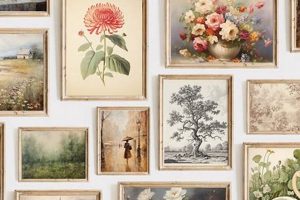
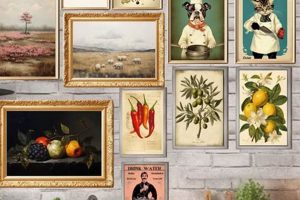
An assemblage of older artistic pieces displayed on a vertical surface, often within a domestic or commercial environment, constitutes a curated aesthetic. These arrangements frequently incorporate artwork spanning different eras, styles, and mediums, contributing to a layered and visually rich presentation. For example, a selection might include framed prints from the Art Deco period alongside salvaged architectural fragments and antique textiles.
Such presentations offer significant advantages, including the creation of a unique and personalized atmosphere, reflecting individual tastes and historical appreciation. Furthermore, the incorporation of older pieces promotes sustainability by repurposing existing items, reducing the demand for newly manufactured decor. Historically, the practice of displaying collected art has signified cultural awareness and served as a visual representation of personal narratives.
Understanding the selection criteria, arrangement principles, and maintenance considerations is essential for effectively implementing this decorative approach. Subsequent sections will delve into specific curatorial strategies, framing options, and preservation techniques to ensure the longevity and visual impact of the artistic display.
Enhancing the Visual Impact
The following recommendations address key considerations for effectively curating and maintaining an arrangement of older artistic pieces on a vertical surface. These guidelines emphasize preservation, aesthetic coherence, and impactful display techniques.
Tip 1: Assess Environmental Conditions: Before installation, evaluate the wall’s exposure to direct sunlight and humidity. Prolonged exposure can damage delicate artwork. Employ UV-protective glazing and dehumidifiers as needed to mitigate potential deterioration.
Tip 2: Establish a Focal Point: Designate a central piece to serve as the visual anchor. Surrounding artwork should complement and enhance this focal point, creating a balanced and hierarchical composition.
Tip 3: Consider Framing Consistency: While eclecticism is encouraged, maintaining a degree of framing consistency can unify the overall presentation. Choose frames that complement the artwork’s style and the room’s decor. Conservation-grade materials are paramount.
Tip 4: Implement Proper Spacing: Careful consideration of the spacing between pieces is crucial. Avoid overcrowding; allow each artwork sufficient visual breathing room to be appreciated individually and as part of the collective display. A consistent interval can bring a sense of design.
Tip 5: Incorporate Varying Heights and Depths: Introduce visual interest by staggering the heights and depths of the pieces. This can be achieved through the use of varying frame thicknesses or by strategically layering smaller artworks in front of larger ones.
Tip 6: Prioritize Archival Mounting Techniques: Employ archival-quality mounting materials and techniques to ensure the long-term preservation of the artwork. Avoid using acidic materials, such as masking tape or standard cardboard, which can cause irreversible damage.
Tip 7: Rotate Artworks Periodically: To prevent overexposure to environmental factors and to maintain visual interest, consider rotating the artworks periodically. Store removed pieces in a dark, climate-controlled environment.
Adherence to these recommendations will not only enhance the aesthetic appeal but also ensure the longevity and preservation of the curated collection. The resulting presentation will serve as a testament to discerning taste and responsible stewardship.
The subsequent discussion will explore specific examples of successful curated displays and provide detailed guidance on conservation strategies.
1. Era Authenticity

Era Authenticity represents a critical dimension in the creation of a display of older artistic pieces. It refers to the degree to which the assembled artworks genuinely reflect and represent the historical period they purport to originate from. Establishing a cohesive era-specific theme elevates the display from a mere collection of old items to a historically informed and aesthetically compelling statement.
- Provenance and Documentation
Establishing the provenance of each piece is crucial for verifying authenticity. Documentation, such as purchase records, exhibition catalogs, or expert appraisals, serves as evidence of the artwork’s history and origin. Without credible provenance, the authenticity of a vintage art piece is questionable, diminishing its value and historical significance within the curated display.
- Material and Technique Analysis
Authentic period pieces exhibit materials and techniques consistent with the era of their creation. For instance, a painting purported to be from the 18th century should exhibit the use of pigments and canvas materials commonly employed during that period. Scientific analysis, such as pigment analysis or radiocarbon dating, can provide objective evidence to support or refute the claimed era of origin.
- Stylistic Consistency
The stylistic characteristics of the artwork should align with the established artistic conventions of the claimed era. For example, a piece labeled as Art Nouveau should exhibit the characteristic flowing lines, organic motifs, and decorative details associated with that movement. Deviations from established stylistic norms raise concerns about authenticity and historical accuracy.
- Framing and Presentation Appropriateness
The framing and presentation of the artwork should be appropriate for the era it represents. Using a modern frame on an antique painting, for example, can detract from its authenticity and historical accuracy. Selecting frames and display methods that are consistent with the period enhances the overall historical integrity of the curated display.
Achieving Era Authenticity in a display of older artistic pieces requires meticulous research, careful evaluation, and a commitment to historical accuracy. By prioritizing provenance, material analysis, stylistic consistency, and appropriate presentation, one can create a display that not only delights the eye but also educates and informs, fostering a deeper appreciation for the art and culture of the past.
2. Artistic Style

Artistic Style serves as a foundational element in the creation and interpretation of a display of older artistic pieces on a wall. The careful selection and arrangement of artwork based on stylistic considerations directly influence the aesthetic impact and communicative power of the display. The integration of disparate styles can create a dynamic tension, highlighting contrasts and revealing unexpected connections, while a more homogeneous stylistic approach can foster a sense of harmony and historical coherence. Without a deliberate engagement with Artistic Style, the assemblage risks becoming a mere collection of unrelated objects, lacking narrative depth or aesthetic unity.
For instance, consider two contrasting approaches. A display featuring a mixture of Impressionist landscapes, Cubist portraits, and Surrealist abstracts will necessitate a curatorial strategy that addresses the inherent stylistic differences. The juxtaposition of these movements might aim to illustrate the evolution of artistic thought or to provoke a dialogue between distinct modes of representation. Alternatively, a display focusing exclusively on the Art Deco period, with its geometric forms, bold colors, and industrial influences, creates a unified visual experience that evokes a specific historical and cultural context. The practical significance lies in understanding how different stylistic choices impact the viewer’s perception and interpretation of the assembled artwork. One can imagine incorporating elements from the baroque style or even integrating elements that appear to be art nouveau.
Ultimately, the intentional manipulation of Artistic Style allows for the creation of a curated display that transcends mere decoration. It becomes a vehicle for conveying meaning, exploring historical trends, and expressing personal aesthetic preferences. The challenge lies in balancing stylistic coherence with visual interest, ensuring that the individual artworks complement one another while contributing to a cohesive and compelling overall narrative. A refined understanding of Artistic Style is, therefore, essential for anyone seeking to create a memorable and impactful arrangement of older artistic pieces.
3. Framing Choices

Framing choices exert a considerable influence on the perception and preservation of older artistic pieces displayed on a wall. These decisions extend beyond mere aesthetics, encompassing archival considerations, visual harmony, and historical context. Thoughtful framing can enhance the artwork’s inherent qualities and protect it from environmental degradation, while unsuitable framing can diminish its impact and accelerate deterioration.
- Material Compatibility
The materials used in framing must be compatible with the artwork’s composition. Acidic materials, such as certain cardboard backings or non-archival tapes, can leach into the artwork, causing discoloration and embrittlement over time. Conservation-grade materials, including acid-free mats and backing boards, are essential to prevent such damage. For example, framing a vintage print with a standard, non-archival mat board can result in “mat burn,” a permanent discoloration along the edges of the print. The implications are clear: selecting inert, stable materials is paramount for long-term preservation.
- Style Complementarity
The style of the frame should complement the artwork’s style and period. A highly ornate, gilded frame might be appropriate for a Baroque painting but would likely clash with a minimalist abstract print. The frame should enhance, not detract from, the artwork’s visual presence. Consider a simple, unadorned wood frame for a mid-century modern piece to maintain its clean aesthetic, or a frame with subtle details that picks up colors from the artwork itself. The careful selection of a frame that harmonizes with the artwork’s style elevates the overall presentation.
- Glazing Considerations
The choice of glazing impacts both the visibility and protection of the artwork. Standard glass offers minimal protection from UV radiation, which can cause fading and discoloration. UV-filtering glass or acrylic shields the artwork from harmful light, preserving its colors and details. Anti-reflective glazing reduces glare, allowing for a clearer view of the artwork. The selection of glazing should balance the need for protection with the desire for optimal viewing conditions. For delicate pastels or watercolors, UV protection is critical to prevent fading, and anti-reflective glazing can minimize glare, allowing viewers to appreciate the subtle nuances of the artwork.
- Mounting Techniques
The method used to mount the artwork within the frame is crucial for its long-term stability. Hinging the artwork with archival-quality paper tape allows it to expand and contract with changes in humidity, preventing buckling and tearing. Avoid using adhesives that can damage the artwork. For example, dry mounting, a process that adheres the artwork to a board with heat-activated adhesive, is generally not recommended for valuable or irreplaceable pieces, as it is irreversible and can lead to deterioration. Proper mounting techniques ensure the artwork remains secure and stable within the frame, minimizing the risk of damage.
The interplay of material compatibility, style complementarity, glazing considerations, and mounting techniques directly influences the aesthetic and archival integrity of the entire display. The decisions made regarding framing are not merely cosmetic; they are integral to the long-term preservation and appreciation of older artistic pieces. Skillful framing ensures the artwork is both visually appealing and protected for future generations.
4. Spatial Arrangement

Spatial arrangement, within the context of a vintage art wall, represents a critical determinant of aesthetic impact and visual coherence. The deliberate placement of individual artworks, their relative proximity, and the overall composition of the display directly influence the viewer’s experience. An ill-conceived arrangement can result in a disjointed and visually confusing presentation, diminishing the impact of each individual piece. Conversely, a well-executed spatial arrangement can elevate the collection, creating a unified and engaging narrative. For example, the Salon style, common in 19th-century exhibitions, involved densely packing artworks from floor to ceiling. This approach, while historically relevant, may prove visually overwhelming in a modern domestic setting, necessitating a more selective and balanced approach. Understanding this connection is therefore essential for curating a display that is both visually pleasing and historically informed.
The practical applications of this understanding are numerous. Consider the impact of symmetrical versus asymmetrical arrangements. A symmetrical layout, with artworks arranged in a balanced and mirrored fashion, can evoke a sense of order and formality. This approach might be suitable for displaying a collection of similarly sized and themed prints. An asymmetrical arrangement, on the other hand, introduces dynamism and visual interest. This technique often involves offsetting different sizes and styles of artwork to create a more relaxed and informal atmosphere. Furthermore, the spacing between individual pieces plays a critical role. Insufficient spacing can lead to visual clutter, while excessive spacing can create a sense of detachment. The ideal spacing allows each artwork to breathe and be appreciated individually, while still contributing to the overall composition. For instance, in a gallery setting, ample space is often allocated around each artwork to encourage focused attention. However, in a more intimate setting, such as a living room, a tighter grouping may be more appropriate to create a sense of warmth and intimacy. By carefully considering these factors, curators can create a visual rhythm that guides the viewer’s eye and enhances the overall impact of the display.
In summary, spatial arrangement is not merely a cosmetic consideration; it is an integral component of a successful vintage art wall. Its impact is manifested in the overall aesthetic coherence, the individual appreciation of each artwork, and the narrative conveyed to the viewer. Challenges arise in balancing historical accuracy with contemporary aesthetic preferences and adapting arrangements to suit different spatial contexts. However, by prioritizing thoughtful planning and attention to detail, curators can overcome these challenges and create displays that are both visually compelling and intellectually engaging, contributing to a deeper appreciation of the art and history they represent.
5. Preservation Methods

The long-term viability of a “vintage art wall” hinges critically upon the consistent and diligent application of appropriate preservation methods. These methods are not merely cosmetic; they constitute a fundamental aspect of responsible stewardship, ensuring that the assembled artworks retain their aesthetic and historical value for future generations. Without a robust preservation strategy, the collection is vulnerable to irreversible damage and eventual degradation, undermining its significance and appeal.
- Environmental Control
Maintaining a stable and controlled environment is paramount for preserving older artistic pieces. Fluctuations in temperature and humidity can cause significant damage, leading to warping, cracking, and discoloration. Ideal conditions typically involve a temperature range of 68-72F (20-22C) and a relative humidity level of 45-55%. Direct sunlight is particularly harmful, as ultraviolet radiation causes fading and embrittlement. Implementing measures such as UV-filtering glazing, climate control systems, and careful placement away from direct light sources is crucial. Consider, for instance, the detrimental effect of prolonged exposure to sunlight on a vintage watercolor painting; the colors will fade, and the paper will become brittle over time. The establishment and maintenance of a stable environment mitigate these risks, ensuring the long-term preservation of the artwork.
- Proper Handling and Storage
The physical handling of older artistic pieces requires careful attention to detail. Unnecessary handling should be minimized, and when handling is required, clean cotton gloves should be worn to prevent the transfer of oils and dirt. When storing artworks not currently on display, they should be wrapped in acid-free paper and stored in a cool, dry, and dark environment. Avoid stacking artworks directly on top of one another, as this can cause surface damage. The careless handling of a fragile vintage photograph, for example, can result in tears, creases, and the loss of irreplaceable details. Adhering to proper handling and storage protocols minimizes the risk of physical damage and ensures the longevity of the collection.
- Pest Management
Insect infestations can pose a significant threat to older artistic pieces, particularly those composed of organic materials such as paper, canvas, and wood. Regular inspections for signs of pest activity are essential. Integrated pest management (IPM) strategies, which emphasize preventative measures and non-toxic treatments, are preferred over the use of harsh chemicals, which can damage the artwork. For instance, silverfish can devour paper-based artworks, leaving behind unsightly damage. Implementing IPM strategies, such as sealing cracks and crevices, maintaining cleanliness, and using insect traps, minimizes the risk of pest infestations and protects the collection from damage.
- Cleaning and Conservation
Regular cleaning and occasional conservation treatments are necessary to maintain the aesthetic and structural integrity of older artistic pieces. Cleaning should be performed gently, using appropriate materials and techniques. Avoid using harsh chemicals or abrasive cleaners, which can damage the surface of the artwork. Conservation treatments, such as repairing tears, removing stains, and consolidating flaking paint, should be performed by qualified professionals. Attempting to clean or repair a valuable vintage oil painting without proper training can result in irreversible damage. Entrusting such tasks to experienced conservators ensures that the artwork receives the appropriate care and treatment, preserving its value and appearance.
In conclusion, the application of robust preservation methods represents a fundamental aspect of curating and maintaining a “vintage art wall”. Environmental control, proper handling and storage, pest management, and appropriate cleaning and conservation treatments collectively contribute to the long-term preservation of the assembled artworks, ensuring that they retain their aesthetic and historical value for future generations. Neglecting these measures can result in irreversible damage and the loss of irreplaceable cultural heritage. Therefore, prioritizing preservation is not merely a matter of aesthetic preference; it is a moral imperative for those entrusted with the stewardship of these valuable objects.
6. Wall Aesthetics

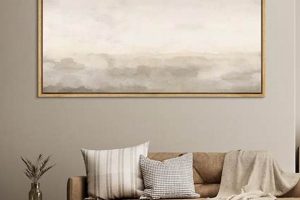
Wall aesthetics function as a foundational element in the successful realization of a curated display of older artistic pieces. The existing visual characteristics of the wall, including its color, texture, and architectural details, directly influence the selection and arrangement of artworks within a “vintage art wall.” A mismatch between the wall’s inherent aesthetic and the chosen artwork can result in a visually jarring and disjointed presentation, diminishing the impact of both the wall and the art. For instance, a heavily textured, dark-colored wall may overwhelm delicate watercolors or prints, while a stark white wall may provide an ideal backdrop for showcasing bold and colorful oil paintings. The practical significance of understanding this connection lies in the ability to create a harmonious and visually compelling display that enhances, rather than detracts from, the overall aesthetic of the space.
Consider the case of a historic home with original plaster walls and ornate moldings. In such a setting, a “vintage art wall” composed of framed antique portraits and landscape paintings would likely complement the existing architectural details, creating a sense of continuity and historical authenticity. Conversely, attempting to display contemporary abstract art against the same backdrop may create a jarring visual contrast, disrupting the intended aesthetic. The choice of wall color also plays a crucial role. Neutral colors, such as off-white or gray, often provide a versatile backdrop for a variety of artworks, while bolder colors can be used to create a more dramatic and visually stimulating effect. However, it is important to ensure that the wall color does not clash with or overpower the artwork. The interplay between lighting and wall color must also be considered. A dark wall color may absorb light, requiring additional illumination to properly showcase the artwork. A bright wall color may reflect light, creating glare and making it difficult to view the artwork properly. Therefore, careful consideration must be given to the existing lighting conditions and the impact of wall color on the overall visual experience.
In conclusion, wall aesthetics are inextricably linked to the success of a “vintage art wall.” By carefully considering the wall’s existing characteristics, curators can select and arrange artworks that complement the space, creating a harmonious and visually compelling display. Challenges arise in adapting the display to suit different wall aesthetics and lighting conditions. However, by prioritizing thoughtful planning and attention to detail, curators can overcome these challenges and create displays that are both visually engaging and historically informed, contributing to a deeper appreciation of the art and the space in which it is presented. The interplay between wall and art is therefore essential in curating a vintage art display.
Frequently Asked Questions
This section addresses common inquiries regarding the creation, maintenance, and preservation of a curated display of older artistic pieces on a vertical surface.
Question 1: What factors determine the suitability of a wall for displaying vintage art?
The structural integrity of the wall is paramount. It must support the weight of the framed artworks. Environmental factors, such as direct sunlight and humidity, also play a crucial role, as these can damage delicate pieces. Finally, aesthetic considerations, including wall color and texture, should complement the artwork.
Question 2: How frequently should a vintage art wall be cleaned and maintained?
Regular dusting, performed with a soft brush, is recommended every one to two months. More intensive cleaning, involving specialized cleaning solutions, should be conducted as needed, typically every six to twelve months, or as advised by a professional conservator.
Question 3: What are the risks associated with improper framing of vintage art?
Improper framing can lead to several issues, including acid migration from non-archival materials, physical damage from inadequate support, and fading due to lack of UV protection. Conservation-grade materials and proper mounting techniques are essential to mitigate these risks.
Question 4: How can one ensure the authenticity of vintage art pieces?
Verifying authenticity requires careful research and examination. Provenance documentation, expert appraisals, and material analysis are valuable tools in determining the age and origin of a piece. Consulting with reputable dealers and art historians is also advisable.
Question 5: What steps can be taken to prevent insect infestations in a vintage art wall display?
Implementing an integrated pest management (IPM) strategy is recommended. This includes regular inspections for signs of pest activity, sealing cracks and crevices, and using non-toxic insect traps. Avoiding the use of harsh chemicals, which can damage the artwork, is also crucial.
Question 6: How does the spatial arrangement of artwork affect the overall aesthetic impact of a vintage art wall?
Spatial arrangement significantly influences the visual coherence of the display. Careful consideration should be given to the size, shape, and style of each piece, as well as the spacing between them. A well-balanced arrangement creates a sense of harmony and visual interest, enhancing the overall aesthetic appeal.
Prioritizing preservation, authentication, and informed arrangement elevates the display from a mere collection to a curated statement.
The subsequent section will explore common pitfalls to avoid when assembling a display.
Vintage Art Wall
The preceding discourse has explored the multifaceted dimensions of the curated assembly of older artistic pieces displayed on a vertical surface. From the imperative of era authenticity and stylistic coherence to the critical considerations of framing choices, spatial arrangement, preservation methods, and the overarching influence of wall aesthetics, the elements that contribute to a successful and enduring display have been examined. Furthermore, frequent inquiries regarding maintenance, authentication, and environmental control have been addressed, underscoring the commitment required for responsible stewardship of these valuable objects.
The creation of a “vintage art wall” is not a trivial undertaking. It necessitates meticulous planning, a discerning eye, and a profound respect for the historical and artistic significance of the chosen pieces. When approached with diligence and informed expertise, such a display transcends mere decoration, becoming a compelling testament to the enduring power of art to connect us to the past, enrich the present, and inspire future generations. Continued research and adherence to best practices are essential to ensure the longevity and cultural impact of these curated collections.