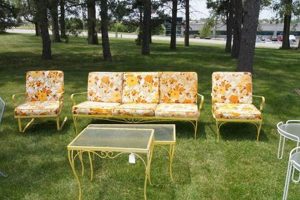
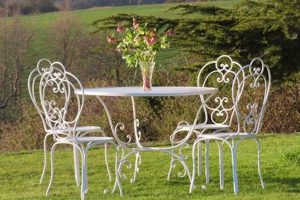
Outdoor furnishings crafted from wrought or cast iron, exhibiting designs and manufacturing techniques characteristic of past eras, are frequently sought after for their durability and aesthetic appeal. These pieces often showcase intricate detailing and robust construction, reflecting craftsmanship from periods such as the Victorian era or the mid-20th century. Examples include ornate benches, tables with elaborate scrollwork, and chairs featuring distinctive patterns.
The enduring popularity of these items stems from their longevity and timeless style. Iron’s inherent strength allows these furnishings to withstand the elements, offering decades of use with proper maintenance. Furthermore, the historical significance and artistic designs associated with such pieces imbue outdoor spaces with a sense of elegance and heritage, enhancing the overall ambiance of gardens, patios, and balconies. Their acquisition also represents a sustainable choice, promoting the reuse of existing materials and reducing the demand for newly manufactured goods.
Subsequent sections will delve into the identification of authentic examples, the proper methods for restoration and maintenance, and considerations for integrating these distinctive elements into contemporary outdoor design schemes. Understanding the nuances of materials, construction, and stylistic trends is crucial for both collectors and those seeking to incorporate these elements into their outdoor spaces.
Acquiring and maintaining outdoor iron furnishings from previous eras demands careful consideration. The following guidelines aim to provide practical advice for identifying, preserving, and utilizing these valuable pieces.
Tip 1: Assess the Iron’s Composition. Differentiate between wrought iron and cast iron. Wrought iron, characterized by its fibrous structure, indicates hand-forging, usually pre-dating the mass production of cast iron. Cast iron, more brittle, often features intricate molded designs.
Tip 2: Examine for Authenticity Marks. Search for foundry marks, date stamps, or manufacturer’s emblems. These marks provide insight into the piece’s origin and age, aiding in valuation and historical context. Consult reference materials to verify authenticity.
Tip 3: Evaluate the Condition Critically. Scrutinize for rust, cracks, and previous repairs. Heavy rust compromises structural integrity. Cracks in cast iron are often irreparable. Document any existing damage meticulously before acquisition.
Tip 4: Understand Restoration Techniques. Investigate appropriate methods for rust removal, repainting, and structural reinforcement. Consult with restoration professionals for significant damage or if lacking experience. Select paints formulated for outdoor iron to prevent future corrosion.
Tip 5: Consider Placement and Environmental Factors. Position pieces strategically to minimize exposure to harsh weather conditions. Regularly clean to prevent dirt and moisture buildup. Employ protective coatings or covers during periods of inactivity.
Tip 6: Research Design Eras. Familiarize with distinct design periods, such as Victorian, Art Nouveau, and Art Deco. Recognizing stylistic cues informs appropriate restoration and integration within outdoor spaces. Avoid anachronistic pairings.
Tip 7: Prioritize Preservation over Alteration. Resist the temptation to drastically modify original designs. Preserving the historical integrity of each piece enhances its value and cultural significance.
Careful selection, preservation, and informed restoration contribute to the longevity and aesthetic value of these outdoor artifacts. Attention to these details ensures the enduring beauty and functionality of these unique pieces.
The subsequent section will explore the impact of these enduring artifacts on outdoor design principles.
1. Material Composition

The material composition of vintage iron patio furniture directly influences its durability, aesthetic characteristics, and restoration requirements. Wrought iron, produced through laborious hand-forging, exhibits a fibrous grain structure imparting superior tensile strength and malleability. This allows for the creation of intricate, flowing designs often found in Victorian-era pieces. Cast iron, conversely, is formed by pouring molten iron into molds, enabling mass production of more complex shapes but resulting in a more brittle material susceptible to cracking under stress. Consequently, identifying the specific type of iron employed in a piece’s construction is crucial for determining appropriate maintenance procedures. For example, attempting to weld cast iron without specialized techniques often results in further damage, highlighting the need for material-specific expertise.
The impact of material composition extends beyond structural integrity to influence aesthetic qualities. Wrought iron’s inherent workability allowed artisans to create elaborate scrollwork and delicate details, imparting a sense of refined elegance often lacking in cast iron pieces. Furthermore, the differing surface textures of each material affect paint adhesion and corrosion resistance. Wrought iron, with its slightly rougher surface, generally holds paint better than the smoother surface of cast iron, requiring different preparation methods for optimal results. A practical example of this is the observation that wrought iron furniture from the same period often exhibits less paint flaking than comparable cast iron pieces due to superior adhesion. This has obvious long-term implications for preservation and the cost of ongoing maintenance.
Understanding the material composition of vintage iron patio furniture serves as a foundational element in preserving its historical integrity and extending its lifespan. Failure to recognize the differences between wrought and cast iron can lead to inappropriate restoration techniques, compromising structural integrity and diminishing aesthetic value. Knowledge of material-specific properties informs informed decisions regarding cleaning, rust removal, repainting, and structural repairs. Ultimately, this understanding allows collectors and enthusiasts to appreciate the craftsmanship and artistry embedded within these pieces and to ensure their continued enjoyment for generations to come.
2. Authenticity Indicators

The determination of genuine vintage iron patio furniture relies heavily on recognizing specific authenticity indicators. These indicators act as verifiable signs of a piece’s age, origin, and manufacturing process, distinguishing authentic items from reproductions. The presence or absence of such indicators directly impacts a piece’s historical value and market price. For instance, original foundry marks, often stamped or cast into the iron, provide irrefutable evidence of the manufacturer and sometimes the year of production. Similarly, particular construction techniques, such as the use of specific types of rivets or welds characteristic of a certain era, serve as crucial indicators. A modern reproduction may mimic the overall design but often lacks the nuanced details and construction methods found in genuine vintage pieces.
Consider, for example, a Victorian-era wrought iron garden bench. An authentic example typically exhibits intricate hand-forged details, whereas a contemporary replica may employ less labor-intensive techniques, resulting in a less refined appearance. Furthermore, the patina the surface discoloration and wear accumulated over time is difficult to replicate convincingly. Close examination of the iron’s surface may reveal subtle variations in texture and color that are indicative of age and environmental exposure. However, it is essential to differentiate between desirable patina and detrimental rust, as excessive corrosion can compromise structural integrity. Comparison with documented examples from reputable sources, such as museum collections or historical catalogs, provides a valuable reference point for verifying authenticity.
Ultimately, the ability to discern authenticity indicators is crucial for both collectors and those seeking to incorporate genuine vintage iron patio furniture into their outdoor spaces. Overlooking these details can lead to the acquisition of misrepresented items and an inaccurate understanding of the piece’s historical context. A thorough investigation of potential purchases, including examination of foundry marks, construction methods, and surface patina, significantly reduces the risk of acquiring reproductions. Careful study of these defining characteristics ensures the preservation and appreciation of authentic examples of iron patio furniture from bygone eras.
3. Structural Integrity

The structural integrity of antique iron outdoor furnishings represents a critical determinant of their value, safety, and long-term usability. The inherent robustness of iron, when uncompromised, allows these pieces to withstand environmental stressors for extended periods. However, age, exposure to the elements, and previous repairs can significantly diminish this initial strength. The effect of diminished structural integrity is multifaceted, ranging from aesthetic degradation to potential collapse. A corroded chair leg, for example, not only detracts from the visual appeal but also presents a risk of failure under load. The importance of structural assessment cannot be overstated; it directly influences the feasibility of restoration, the cost of repairs, and the suitability of the furniture for its intended purpose. A table with hairline fractures in its cast iron top, if left untreated, will progressively weaken and eventually become unusable.
The assessment of structural integrity involves a systematic examination for common failure points. These include rust-induced section loss, particularly at joints and ground contact points; cracking in cast iron components due to fatigue or impact; and distortion or bending of wrought iron elements from overloading. The presence of non-original welds or repairs warrants careful scrutiny, as improper welding techniques can introduce stress concentrations that accelerate failure. Evaluating the stability of the piece is equally important. Wobbly legs, uneven surfaces, or excessive play in moving parts indicate underlying structural issues that require attention. Consider a Victorian-era bench discovered in a garden; its wrought iron frame, although seemingly intact, may exhibit significant rust pitting along the base where it contacted the soil, necessitating extensive repair or replacement of weakened sections.
In conclusion, the evaluation of structural integrity is paramount in the context of vintage iron patio furniture. A comprehensive assessment, encompassing visual inspection, stability testing, and scrutiny of previous repairs, informs decisions regarding restoration, conservation, and intended use. Addressing structural deficiencies not only safeguards the furniture against further deterioration but also ensures the safety of its users. While aesthetic considerations are important, prioritizing structural soundness remains the cornerstone of responsible ownership and preservation of these enduring artifacts.
4. Restoration Potential

The “restoration potential” of an outdoor furnishing fundamentally determines its feasibility of reclaiming antique iron garden pieces. The assessment of this potential involves careful consideration of the object’s current condition, the availability of replacement parts or compatible materials, and the expertise required to execute the restoration process. The existence or lack of restoration potential significantly impacts the economic viability and the aesthetic outcome of attempting to revitalize these items. For instance, furniture severely corroded to the point of structural instability possesses a low restoration potential. The cause being excessive exposure to moisture and the effect requiring extensive metal replacement, increasing both cost and complexity. Conversely, a piece with superficial rust and minor damage presents high restoration potential as interventions are minimally invasive and economically justifiable.
The ability to accurately assess restoration potential relies on a comprehensive understanding of ironwork techniques and materials specific to the piece’s era. Early 20th-century cast iron furniture, for example, may require different welding or joining methods compared to late 19th-century wrought iron pieces. The practicality of restoration hinges on identifying compatible repair materials and possessing the necessary skill to execute repairs without compromising the piece’s original integrity. An illustration of this could be sourcing matching scrollwork for a damaged Victorian bench. If the design is exceptionally intricate or rare, the restoration potential diminishes due to the difficulty in finding or replicating the missing element. Professional restoration services are often required to ensure the conservation adheres to established ethical guidelines, respecting the historical character of the artifact while ensuring its continued use.
In summary, restoration potential serves as a crucial factor in the lifecycle management of vintage iron patio furniture. The evaluation of this potential dictates whether a piece is destined for sympathetic restoration, faithful reproduction, or irreparable discard. Accurate assessment protects the value and historical integrity of these objects, guiding the application of resources and expertise. Disregard of this assessment could lead to misguided restoration efforts, resulting in the irreversible damage or loss of original components. Thus, a balanced approach recognizing both the opportunities and the limitations of restoration potential is essential for both preserving and enjoying vintage iron garden furniture.
5. Design Era

The design era of vintage iron patio furniture establishes its aesthetic identity and reveals details about its social and technological context. Understanding the prevalent design philosophies of a particular era provides essential insights into the furniture’s stylistic characteristics, manufacturing processes, and intended use.
- Victorian Era (c. 1837-1901)
Victorian iron furniture is characterized by ornate embellishments, intricate scrollwork, and a focus on elaborate detailing. Cast iron was frequently employed to create elaborate patterns inspired by nature. Examples include benches and chairs adorned with floral motifs and asymmetrical designs. Its existence signifies a cultural emphasis on status and refinement, often found in formal gardens and estates.
- Art Nouveau (c. 1890-1910)
This era exhibits flowing, organic forms inspired by the natural world, often featuring sinuous lines and stylized botanical motifs. Wrought iron was favored for its malleability, allowing artisans to create fluid, asymmetrical designs. Examples include chairs and tables with elongated legs and curvilinear backrests. This signifies a move toward artistic expression and a rejection of industrial uniformity, commonly seen in artistically-inclined households.
- Art Deco (c. 1920-1939)
Art Deco furniture is characterized by geometric shapes, streamlined forms, and a celebration of industrial materials. Iron was often combined with other materials, such as glass or chrome, to create sleek and modern designs. Examples include tables with geometric bases and chairs with angular silhouettes. This exemplifies a cultural fascination with technology, often featured in modern homes and public spaces.
- Mid-Century Modern (c. 1945-1965)
Focusing on functionality, simplicity, and clean lines define Mid-Century Modern aesthetics. Iron was employed to create lightweight, minimalist furniture often combined with materials like wood or vinyl. Examples include wire-frame chairs and tables with simple geometric forms. Demonstrating a cultural emphasis on practicality and affordability, commonly found in suburban homes.
The design era serves as a lens through which to appreciate vintage iron patio furniture, providing clues to the piece’s origins, cultural significance, and aesthetic value. Recognizing these stylistic characteristics allows for informed purchasing decisions, appropriate restoration techniques, and a deeper understanding of the furniture’s place in design history.
Frequently Asked Questions
The following section addresses common inquiries and concerns regarding the identification, acquisition, preservation, and restoration of iron outdoor furnishings. The intent is to provide clarity and informed guidance to enthusiasts and collectors.
Question 1: What are the primary differences between wrought iron and cast iron, and how do these differences affect care requirements?
Wrought iron, produced through hammering and shaping heated iron, exhibits a fibrous grain structure, granting superior strength and malleability. Cast iron, conversely, is created by pouring molten iron into molds, resulting in a more brittle and less flexible material. Wrought iron is generally more resistant to corrosion and easier to repair through welding, while cast iron is more prone to cracking and requires specialized welding techniques.
Question 2: How can authenticity of vintage iron patio furniture be determined?
Authenticity can be assessed through examination of foundry marks, construction techniques, and design details. Original foundry marks, typically stamped or cast into the iron, provide verifiable evidence of the manufacturer and date of production. Period-specific construction methods, such as the use of specific rivets or welds, serve as additional indicators. Comparison with documented examples from historical catalogs or museum collections is also advisable.
Question 3: What are the key considerations when assessing the structural integrity of vintage iron patio furniture?
Assessment should focus on identifying signs of corrosion, cracking, distortion, and previous repairs. Rust-induced section loss is a common concern, particularly at joints and ground contact points. Cracks in cast iron components require careful evaluation, as they are often irreparable. The stability of the piece should also be assessed to identify underlying structural issues.
Question 4: What are the recommended methods for rust removal and prevention on outdoor iron furniture?
Rust removal methods vary depending on the severity of the corrosion. Light surface rust can be removed through manual abrasion using wire brushes or abrasive pads. More severe corrosion may require chemical rust removers or sandblasting. Following rust removal, the iron should be primed with a rust-inhibiting primer and coated with a durable outdoor paint to prevent future corrosion.
Question 5: How can the aesthetic integrity of vintage iron patio furniture be preserved during restoration?
Preservation of aesthetic integrity necessitates careful consideration of original finishes and design details. When repainting, select colors and finishes that are consistent with the piece’s original appearance. Avoid drastic alterations to the original design. Prioritize the preservation of existing patina, as it contributes to the piece’s historical character.
Question 6: What factors should be considered when incorporating vintage iron patio furniture into modern outdoor spaces?
Integration of vintage pieces into contemporary settings requires careful consideration of scale, proportion, and stylistic compatibility. Select pieces that complement the overall design aesthetic of the outdoor space. Avoid overcrowding or clashing styles. Consider the practical aspects of the furniture’s use, ensuring it is comfortable and functional for its intended purpose.
In conclusion, acquiring and maintaining vintage iron patio furniture demands informed decision-making based on an understanding of materials, construction techniques, and historical context. Careful attention to these details ensures the longevity and aesthetic appreciation of these unique pieces.
The next section will address long-term care and preservation strategies.
Vintage Iron Patio Furniture
This exposition has delved into the multifaceted world of antique iron furnishings, elucidating essential considerations for their identification, preservation, and integration within contemporary spaces. Key aspects explored encompass material composition, indicators of authenticity, structural assessment, restoration potential, and understanding design eras. Careful consideration of these factors is paramount for informed acquisition and responsible stewardship of these artifacts.
The enduring value of vintage iron patio furniture lies not only in its aesthetic appeal but also in its embodiment of historical craftsmanship and design evolution. Continued commitment to responsible conservation practices ensures the preservation of these tangible links to the past, allowing future generations to appreciate their unique character and enduring legacy. Embrace the responsibility of guardianship, safeguarding these pieces for posterity.