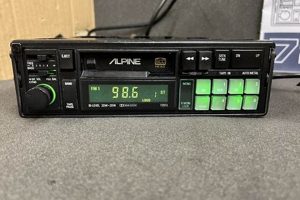
The fusion of classic aesthetics with modern technology is exemplified by head units that mimic the design of older automotive sound systems while incorporating contemporary features. These devices typically feature retro styling, such as knobs, pushbuttons, and analog displays, but internally house digital components like Bluetooth connectivity for wireless audio streaming and hands-free calling.
These units provide a unique blend of functionality and visual appeal. They allow drivers to enjoy the convenience of modern audio sources, such as smartphones and streaming services, without sacrificing the vintage interior styling of their classic vehicles. This preserves the original look and feel of the car’s dashboard, a feature valued by enthusiasts and collectors alike. The incorporation of Bluetooth enhances safety by enabling hands-free communication and navigation, reducing driver distraction.
The following sections will delve into the specific considerations for selecting and installing such a system, exploring the various models available, and examining the technical aspects that ensure seamless integration with a classic automobile’s electrical system.
Essential Considerations for Integrating Retro-Styled Automotive Audio with Bluetooth
Careful planning and execution are crucial when installing a modern audio receiver styled after vintage units. Adherence to best practices ensures optimal performance and preserves the integrity of the vehicle’s original design.
Tip 1: Prioritize Accurate Dimensional Measurements: Ensure the chosen unit’s physical dimensions are compatible with the vehicle’s existing radio slot. Mismatched dimensions can lead to irreversible modifications of the dashboard, diminishing the vehicle’s value.
Tip 2: Verify Voltage Compatibility: Classic vehicles often operate on different voltage systems than modern electronics. Confirm the receiver’s voltage requirements and utilize a voltage regulator or converter if necessary to prevent damage.
Tip 3: Assess Speaker Impedance and Wiring: Inspect the existing speaker impedance to ensure it is compatible with the new head unit. Incompatible impedance can result in poor audio quality or damage to the amplifier. Evaluate the existing wiring and replace any frayed or deteriorated sections to ensure reliable signal transmission.
Tip 4: Discreetly Conceal Modern Wiring: Maintain the vintage aesthetic by carefully concealing modern wiring harnesses and connections. Utilize wire looms and routing techniques that minimize visual intrusion into the original interior.
Tip 5: Thoroughly Test Bluetooth Functionality: Before finalizing the installation, thoroughly test the Bluetooth connectivity with various devices. Verify successful pairing, audio streaming quality, and hands-free calling functionality.
Tip 6: Consider External Amplifier Integration: If the internal amplifier of the unit is insufficient for desired audio output, explore the option of integrating an external amplifier. Ensure the external amplifier is also appropriately matched to the speaker impedance and voltage system.
Tip 7: Preserve Original Components: When possible, retain the original radio unit and associated components. This allows for future restoration to the vehicle’s original factory condition, should the owner desire.
Proper selection and installation result in a seamless blend of classic aesthetics and modern functionality, enhancing the driving experience without compromising the vehicle’s heritage.
The following sections will provide information on troubleshooting common issues and maintaining the longevity of the system.
1. Appearance

In the context of audio receivers blending classic aesthetics with contemporary functionality, the “Appearance” factor is paramount. It directly influences the perceived value and the seamless integration of the unit within a vintage vehicle’s interior. A successful design effectively bridges the gap between historical authenticity and modern technological expectations.
- Visual Authenticity of Faceplate and Controls
The faceplate design, control knobs, and button styles are critical in replicating a period-correct look. Detailing such as font types, color palettes, and material finisheschrome, brushed metal, or Bakelite-like plasticscontribute significantly to the unit’s vintage aesthetic. Reproduction efforts must consider the specific era the vehicle represents to maintain consistency. For instance, a receiver intended for a 1960s car should feature design elements distinct from those of a 1980s vehicle.
- Illumination and Display Characteristics
The illumination of the display and control elements plays a key role in visual integration. Historically accurate lightingoften achieved through subtle incandescent bulbs or filtered LEDs mimicking their colorprevents a jarring contrast with the vehicle’s original interior lighting. Display technologies, such as vacuum fluorescent displays (VFDs) carefully masked to emulate analog meters or Nixie tubes, further enhance the vintage illusion.
- Physical Dimensions and Proportions
The unit’s physical size and proportions must align with the original radio slot or designated mounting location within the vehicle’s dashboard. Deviations from the original dimensions can lead to fitment issues, requiring modifications to the dashboard that compromise the vehicle’s originality and value. Careful attention to depth, width, and height ensures a seamless installation that appears factory-installed.
- Material Selection and Finish Quality
The choice of materials and their finishing directly impacts the tactile feel and overall perceived quality of the unit. Durable, high-quality plastics, metals, and coatings are essential for replicating the robust construction of vintage audio equipment. Accurate reproduction of textures, such as grained plastics or brushed metal surfaces, further enhances the authenticity of the appearance.
Consideration of these elements is essential for any system seeking to successfully capture a vintage visual design, providing a cohesive aesthetic. These details blend to create a product that satisfies the desire for modern functionality while honoring the vehicle’s historical character and visual appeal.
2. Connectivity

In the realm of automotive audio, “Connectivity” represents a critical bridge between the vintage aesthetic of retro-styled head units and the demands of modern audio consumption habits. The ability to seamlessly integrate contemporary devices and media sources is a primary driver for consumers seeking to upgrade their classic vehicles’ sound systems without compromising their original character.
- Bluetooth Audio Streaming
Bluetooth audio streaming enables wireless playback of music and other audio content from smartphones, tablets, and other Bluetooth-enabled devices. This eliminates the need for physical media or wired connections, providing a clean and convenient user experience. The implications for units designed with vintage styling are significant, as the absence of visible wires preserves the authentic look of the dashboard while offering access to vast digital music libraries. For example, one may stream music from Spotify through a radio that looks like it came straight from 1965.
- Hands-Free Calling
The integration of hands-free calling functionality via Bluetooth enhances safety and convenience. Drivers can answer and place calls without removing their hands from the steering wheel, reducing distractions and promoting safer driving practices. This feature is particularly relevant in classic vehicles that may lack modern safety features, providing a technological upgrade that enhances driver awareness and responsiveness.
- Auxiliary Input (AUX)
While Bluetooth offers wireless convenience, the inclusion of an auxiliary input provides a wired connection option for devices that may not support Bluetooth or for situations where a direct connection is preferred. This versatility ensures compatibility with a wider range of audio sources, including older devices or specialized audio equipment. It is useful, for example, to connect an old CD player to have modern and vintage audio output options.
- USB Connectivity and Media Playback
USB connectivity allows for the playback of audio files from USB drives and provides a charging port for mobile devices. This feature is useful for storing and accessing large music collections without relying on streaming services or physical media. The charging capability is an added convenience, ensuring that mobile devices remain powered during extended drives. Modern receivers also play audio through USB, and this is an expectation even on vintage looking devices.
These facets of connectivity, when implemented thoughtfully in retro-styled audio receivers, strike a balance between modern functionality and classic design. The result is an enhanced driving experience that preserves the integrity of the vehicle’s vintage aesthetic while providing access to a wide range of audio sources and communication capabilities.
3. Installation

The process of “Installation” is a critical determinant of the success and longevity of any integration endeavor, particularly when considering audio systems that blend a “vintage look” with modern Bluetooth capabilities. Careful execution is paramount to maintaining the aesthetic integrity of the vehicle while ensuring reliable and safe operation.
- Physical Fit and Mounting
Achieving a seamless physical fit within the vehicle’s dashboard is often the first, and potentially most challenging, step. Original radio slots in classic cars frequently deviate from standardized DIN or double-DIN dimensions. Adapters, custom mounting brackets, or even minor modifications to the dashboard may be required. Improper fitment can lead to unsightly gaps, instability, and potential damage to the unit or the vehicle’s interior. For instance, a unit designed for a 1967 Mustang must occupy the intended space without requiring irreversible alteration to the dashboard.
- Electrical Wiring and Connections
Integrating the new unit into the vehicle’s existing electrical system demands meticulous attention. Older vehicles may utilize different voltage systems (e.g., 6-volt positive ground) or wiring configurations than modern systems. Adapters, voltage converters, and careful identification of power, ground, and speaker wires are essential. Incorrect wiring can result in damage to the unit, the vehicle’s electrical system, or even fire hazards. Adapting a modern 12v receiver to a classic car requires voltage conversion and sometimes a fuse block update.
- Speaker Compatibility and Impedance Matching
The impedance of the vehicle’s original speakers must be compatible with the output impedance of the new receiver. Mismatched impedance can lead to poor audio quality, distortion, or damage to the amplifier within the receiver. If the original speakers are not compatible, replacement with appropriate aftermarket speakers may be necessary. Ensure old speakers do not have a low impedance to prevent damage to the amplifier of a new receiver.
- Antenna Connection and Signal Reception
The antenna connection must be properly adapted to ensure adequate signal reception. Classic cars may utilize different antenna connectors or cable types than modern vehicles. Adapters are typically required to ensure a secure and reliable connection. Poor antenna connections can result in weak signal strength and diminished audio quality. Some vehicles require installing a new antenna to receive modern radio bands.
These are not just steps; they represent a holistic approach to integration that addresses both functional requirements and aesthetic considerations. A well-executed installation results in a system that not only delivers modern audio capabilities but also seamlessly blends into the vehicle’s existing interior, preserving its vintage charm and value.
4. Functionality

In the context of retro-styled automotive audio systems incorporating Bluetooth technology, the element of “Functionality” defines the extent to which these units can meet the expectations of modern users while remaining true to their vintage aesthetic. This includes core operations as well as advanced features that extend the capabilities of classic car audio beyond basic radio reception.
- Audio Source Diversity
While maintaining a vintage appearance, these units must support a range of audio sources. This extends beyond AM/FM radio to include Bluetooth streaming from mobile devices, USB input for digital audio files, and potentially auxiliary input for connecting older devices like CD players or cassette decks. The ability to seamlessly switch between these sources without compromising audio quality is critical. The inclusion of pre-amp outputs for external amplifiers further enhances this aspect, enabling users to upgrade the audio power without altering the head unit itself.
- Hands-Free Calling Integration
Bluetooth technology enables hands-free calling, a safety and convenience feature expected in modern vehicles. The effectiveness of this feature depends on the clarity of the microphone input and the quality of the audio output during calls. Noise cancellation technology is often incorporated to minimize background noise and improve call clarity, particularly in older vehicles with less sound insulation. The user interface for answering and initiating calls must be intuitive and easy to operate while driving.
- User Interface and Control Ergonomics
While emulating the look of vintage radios with knobs, buttons, and analog displays, the user interface must remain functional and intuitive. Controls should be responsive and easy to operate, even while driving. Modern features like digital tuning, station presets, and menu navigation should be integrated without sacrificing the overall vintage aesthetic. This can be achieved through careful design of the display and control layout, ensuring that essential functions are easily accessible. The user interface should blend in and not be too obvious. For example, using the tuning knob for volume instead of a digital up/down control.
- Audio Processing and Equalization
Modern audio processing capabilities, such as digital signal processing (DSP) and equalization, are often incorporated to enhance the sound quality and tailor the audio output to the vehicle’s acoustics. These features allow users to adjust the frequency response, balance, and other audio parameters to achieve optimal sound quality. Preset equalization modes can be included for different music genres, simplifying the adjustment process for less experienced users. The quality of audio reproduction is important; a vintage look should not be at the expense of sound quality.
These elements of functionality, when carefully considered and implemented, allow audio systems to deliver a modern audio experience within a vintage aesthetic. These systems offer features that enhance the driving experience while respecting the vehicle’s historical character, broadening market appeal and customer satisfaction.
5. Compatibility

The effective integration of a vintage-styled head unit with modern Bluetooth capability is significantly determined by its compatibility with the target vehicle’s existing systems and prevailing standards. Overlooking compatibility factors can lead to functional impairment, system instability, or irreversible damage to the vehicle’s electrical components. Adherence to best practices in assessing and ensuring compatibility is thus a critical aspect of installation.
- Voltage Compatibility
Many classic automobiles operate on 6-volt electrical systems, while modern electronics typically require 12 volts. Direct connection of a 12-volt head unit to a 6-volt system will result in insufficient power delivery and potential malfunction. Conversely, attempting to power a 6-volt device with 12 volts can cause irreversible damage. Voltage converters or regulators are essential to bridge this gap, ensuring stable and appropriate power delivery. For example, installing a modern head unit in a pre-1955 vehicle necessitates voltage conversion to avoid electrical damage.
- Speaker Impedance Matching
The impedance of the speakers must be appropriately matched to the output impedance of the head unit’s amplifier. A mismatch can lead to poor audio quality, distortion, or damage to the amplifier. Classic vehicles often have speakers with different impedance ratings than modern units are designed for. Utilizing impedance matching adapters or replacing the speakers with compatible units are necessary steps. An 8-ohm speaker connected to a 4-ohm amplifier output, for example, will result in reduced power output and may damage the amplifier over time.
- Physical Dimensional Compatibility
The dimensions of the head unit must align with the available space in the vehicle’s dashboard. Original radio slots often deviate from standardized DIN or double-DIN sizes. Adapters, custom mounting brackets, or modifications to the dashboard may be required to achieve a secure and aesthetically pleasing fit. Attempting to force a unit into an undersized opening can damage both the unit and the dashboard. Prior verification of dimensions is crucial to prevent irreversible modifications.
- Antenna Compatibility
The antenna connector on the head unit must be compatible with the vehicle’s antenna cable. Adapters are often needed to bridge differences in connector types. Additionally, the antenna itself must be capable of receiving the desired radio frequencies. Some vintage vehicles have antennas optimized for AM frequencies, requiring replacement or supplementation with a modern FM antenna for optimal reception. Adapters and signal boosters can aid in antenna system compatibility.
These facets of compatibility underscore the complexity involved in integrating modern technology into classic vehicles. Successful integration hinges on a thorough understanding of both the vehicle’s original electrical and mechanical specifications and the requirements of the chosen head unit. Proper assessment and implementation of compatibility measures ensure functionality and preserve the integrity of the vehicle.
6. Authenticity
The concept of authenticity, when applied to retro-styled automotive audio receivers with Bluetooth, extends beyond mere visual mimicry. It represents a commitment to replicating the details, materials, and operational characteristics of original equipment, thereby preserving the historical integrity of the vehicle. The cause-and-effect relationship is clear: an increased emphasis on authenticity directly enhances the perceived value and collectibility of both the vehicle and the aftermarket audio system.
Authenticity’s importance lies in its ability to evoke a specific era. A head unit designed to resemble a 1960s radio, for instance, would ideally feature push-button controls, a horizontally oriented dial scale, and a specific font type for station identification. Inaccurate details diminish the illusion and detract from the vehicle’s overall historical accuracy. The practical significance lies in the ability of the system to enhance, rather than detract from, the value of the classic car. For example, the Becker Mexico radio, famed for its association with Mercedes-Benz vehicles, is highly sought after. A modern reproduction that accurately mirrors its appearance would be valued for its ability to blend seamlessly with the vehicle’s original interior.
Challenges in achieving authenticity include sourcing period-correct materials, replicating the tactile feel of original controls, and accurately simulating the lighting characteristics of vintage displays. Despite these challenges, the rewards of a well-executed design are substantial. By prioritizing authenticity, manufacturers can create products that not only meet the functional needs of modern drivers but also contribute to the preservation and appreciation of automotive history. The effect is a classic design with the advantages of modern tech.
Frequently Asked Questions
This section addresses common inquiries regarding audio receivers designed to emulate the aesthetic of vintage car radios while incorporating modern Bluetooth technology.
Question 1: Does the integration of Bluetooth compromise the vintage appearance of the unit?
The integration of Bluetooth can be achieved without significant visual compromise. Manufacturers often conceal the Bluetooth module and antenna internally, preserving the external aesthetic of the vintage-style radio. User interfaces for Bluetooth pairing and control can be discreetly incorporated into existing knobs or buttons, minimizing any disruption to the overall design.
Question 2: Are these units compatible with all classic car models?
Compatibility varies depending on the specific unit and the vehicle’s original radio dimensions, voltage, and speaker impedance. Careful measurement of the existing radio slot and assessment of the vehicle’s electrical system are essential. Adapters and voltage converters may be required to ensure proper fit and function. Professional installation is recommended to guarantee compatibility and prevent damage.
Question 3: Will the audio quality be comparable to modern car stereos?
Audio quality is dependent on the unit’s internal components, including the amplifier and digital signal processor. Higher-quality units can deliver audio performance comparable to modern car stereos. However, some models may prioritize aesthetics over sound quality. Reading reviews and comparing specifications is recommended to ensure satisfactory audio performance.
Question 4: Is professional installation required, or can it be a DIY project?
While some individuals with experience in automotive electrical systems may be capable of performing the installation themselves, professional installation is generally recommended. Improper wiring or installation can damage the unit, the vehicle’s electrical system, or result in safety hazards. Professional installers have the knowledge and tools to ensure a safe and reliable installation.
Question 5: Do these units offer any warranty or support?
Warranty and support policies vary depending on the manufacturer. It is advisable to purchase from reputable brands that offer comprehensive warranties and readily available customer support. Reviewing warranty terms and support options before purchasing is essential.
Question 6: What is the typical lifespan of a vintage-look car stereo with Bluetooth?
The lifespan of these units depends on the quality of the components, the operating environment, and the frequency of use. Units constructed with durable materials and subjected to proper care can last for many years. Protection from extreme temperatures and moisture is recommended to extend their lifespan.
The decision to integrate such a system requires careful consideration of the vehicle’s specifics, the desired level of functionality, and the importance placed on maintaining a classic appearance.
The following section will elaborate on best practices for maintaining the unit and troubleshooting common problems.
Conclusion
The preceding exploration of “vintage look car stereo bluetooth” demonstrates the inherent complexities in harmonizing historical aesthetics with contemporary technological demands. Critical factors such as physical compatibility, electrical integration, and functional requirements must be meticulously addressed to ensure a successful implementation. The synthesis of classic visual design with modern wireless capability requires a nuanced understanding of both automotive history and contemporary electronics.
The decision to incorporate such a system necessitates careful consideration. Prospective adopters are advised to prioritize thorough research, professional consultation, and a measured approach to installation. The successful integration of “vintage look car stereo bluetooth” represents a commitment to preserving automotive heritage while embracing the conveniences of modern technology. Further advancements in miniaturization and design sophistication are anticipated to refine this synthesis, offering increasingly seamless and authentic integrations in the future.