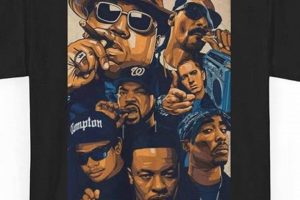
Apparel featuring the image or likeness of the late rapper Tupac Shakur, produced during his lifetime or shortly thereafter and demonstrating characteristics of age and previous ownership, can be classified as a collectible item. These garments often exhibit fading, cracking of printed graphics, or other signs of wear indicative of their age and origins. An example would be a black cotton crew neck with a screen-printed portrait from the ‘All Eyez on Me’ album era, showing significant distress to the print.
Such articles of clothing hold value for several reasons. They represent a tangible connection to a significant figure in music history and a particular era. The rarity of specific designs and the limited availability of well-preserved examples contribute to their desirability among collectors. Their existence provides a visual and material record of the artist’s impact on popular culture and fashion trends of the time.
The following sections will delve into aspects such as identifying authentic examples, assessing their condition and value, and exploring the market dynamics surrounding these sought-after pieces of music memorabilia.
The acquisition of memorabilia necessitates a careful approach to ensure authenticity and value. Due diligence is crucial in assessing garments associated with iconic figures such as Tupac Shakur.
Tip 1: Examine the Garment’s Tag. Authentic items from the 1990s often feature specific brand tags, such as those from Hanes, Fruit of the Loom, or Anvil. Researching common tag styles of the era can help verify the piece’s age. A tag marked with a modern brand, or one inconsistent with manufacturing practices of the period, is a strong indicator of reproduction.
Tip 2: Assess the Print Quality. Screen-printed graphics from the relevant period typically exhibit a certain level of wear and cracking due to age and use. Graphics that appear too pristine or utilize printing techniques not available at the time should be viewed with skepticism. Examine the ink type and application method for consistency with historical practices.
Tip 3: Scrutinize the Stitching. Vintage garments often feature single-stitch construction, particularly along the sleeves and hem. Modern manufacturing commonly uses double-stitch construction for increased durability. While not a definitive indicator, single-stitch construction can support the claim of vintage origin.
Tip 4: Evaluate Fabric and Condition. The fabric should reflect the characteristics of textiles used during the specified period. Examine the garment for signs of wear consistent with age, such as fading, minor stains, or small holes. A garment in excessively pristine condition may raise concerns about its authenticity.
Tip 5: Research the Design’s Origin. Verify the design’s legitimacy and its association with the artist. Official merchandise typically features copyright information or branding related to the artist or their record label. Investigate the design’s presence in official promotional materials or concert programs from the era.
Tip 6: Seek Expert Opinion. Consult with knowledgeable collectors or appraisers specializing in music memorabilia. Their expertise can provide valuable insights into the garment’s authenticity and fair market value. Consider obtaining a professional authentication for high-value items.
These considerations aim to facilitate informed decisions when acquiring collectible musical apparel. A thorough evaluation of construction, design, and provenance is essential to avoid potential misrepresentation.
The following section will explore the potential value and market fluctuations associated with these items.
1. Authenticity

The assessment of legitimacy is paramount in the realm of collectible apparel associated with Tupac Shakur. Verifying that an item is a genuine product of its claimed era and origin significantly impacts its value and desirability among collectors. The presence of verifiable authenticity distinguishes a valuable historical artifact from a mere reproduction.
- Era-Consistent Branding
The presence of brand insignias and labels consistent with the manufacturing practices of the 1990s is a critical indicator. Garments produced during this period typically feature specific branding styles from established apparel manufacturers. Discrepancies between the branding and the claimed era suggest a potential lack of legitimacy. For example, a garment with a 1996 graphic but a tag from a brand that didn’t exist until 2010 would be suspect.
- Print Technology Verification
The screen-printing techniques employed during Tupac Shakur’s active years possess distinct characteristics. Examination of the ink type, layering, and application methods can reveal whether the printing process aligns with the technological capabilities of the era. Modern printing techniques, such as direct-to-garment printing, were not prevalent during that time, and their presence would indicate a reproduction.
- Copyright and Licensing Marks
Official merchandise produced during the artist’s lifetime often bears copyright notices or licensing agreements associated with the record label, management, or estate. The absence of such markings, particularly on designs that were widely distributed, can raise concerns about the garment’s authenticity. Conversely, the presence of incorrect or anachronistic copyright information also signals a potential issue.
- Provenance and Documentation
Establishing a verifiable history of ownership or origin can substantially bolster the claim of legitimacy. Documentation such as purchase receipts from the period, concert tickets, or photographs depicting the garment being worn during the relevant era can serve as supporting evidence. Items with a documented provenance are generally considered more valuable and desirable by collectors.
These facets of authenticity, when considered collectively, provide a framework for assessing the legitimacy of apparel. Scrutinizing these details allows collectors to discern genuine pieces from reproductions, ensuring that their acquisitions represent authentic artifacts of music history. Failure to thoroughly assess a garment can result in the purchase of a counterfeit item, which holds significantly less value and historical significance.
2. Rarity
The scarcity of specific designs within the realm of apparel featuring Tupac Shakur significantly influences its collectibility and valuation. Limited production runs, exclusive distribution channels, and the passage of time all contribute to the rarity of certain examples.
- Limited Edition Releases
Certain designs may have been produced in restricted quantities, often associated with specific events, tours, or promotional campaigns. These limited-edition pieces are inherently rarer due to their deliberate scarcity. An example would be a shirt produced exclusively for crew members during a particular concert tour; its distribution was intentionally limited from the outset, enhancing its desirability among collectors.
- Regional Exclusivity
Some items were distributed only within specific geographic regions or markets. This regional limitation reduces the overall availability of the item, making it more difficult to acquire outside of its original distribution area. For instance, a shirt sold exclusively at a concert venue in California would be considered rarer in other parts of the world.
- Design Variations and Prototypes
Uncommon design variations, misprints, or prototype versions of apparel can be exceptionally rare. These deviations from the standard production run are often highly sought after by collectors due to their unique characteristics and limited existence. An example might be a shirt with a printing error or a color scheme that was never officially released.
- Licensed vs. Unlicensed Merchandise
Officially licensed merchandise, particularly from the artist’s lifetime, tends to be rarer than unlicensed or bootleg items produced later. Licensed merchandise adhered to specific production standards and distribution channels, resulting in a limited supply compared to the often mass-produced and readily available unlicensed counterparts.
The interplay of these factors dictates the scarcity, and consequently the value, of apparel associated with Tupac Shakur. The more restricted the initial production or distribution, and the fewer examples that survive to the present day in acceptable condition, the greater the perceived rarity and the higher the price a collector may be willing to pay.
3. Condition
The state of preservation significantly influences the value and desirability of apparel featuring Tupac Shakur. Garments originating from the 1990s are inherently subject to the effects of age, storage conditions, and prior use. Therefore, the extent to which these elements have impacted the item directly affects its market worth. A shirt exhibiting minimal wear, with vibrant graphics and intact fabric, commands a substantially higher premium than a heavily worn or damaged example.
Factors affecting the condition include the presence of staining, discoloration, tearing, and graphic degradation. Screen-printed designs, common on garments from this era, are prone to cracking or fading over time. The integrity of the fabric itself is also crucial; shrinkage, stretching, or weakening of the fibers detract from the item’s overall value. For example, a shirt with a clear and unfaded image, free from holes and with minimal pilling, would be considered in superior condition. Conversely, one with significant cracking of the graphic, prominent stains, or fabric damage would be deemed less desirable. Proper storage, away from direct sunlight and moisture, plays a critical role in maintaining the garment’s condition over time.
Ultimately, condition serves as a primary determinant in assessing the appeal and market price of collectibles. Understanding the nuances of wear and degradation allows collectors to make informed decisions, balancing their budget with the desired level of preservation. While some minor imperfections may be acceptable in vintage items, significant damage generally diminishes the garment’s value and long-term collectibility.
4. Design

The graphic representation and stylistic elements are integral to the assessment of a vintage Tupac Shakur garment. The design serves as an immediate identifier, linking the item to a specific period, album release, or cultural event. Authentic examples often feature imagery directly related to the artist’s work, such as album artwork, promotional photographs, or logos associated with his record label. The arrangement of these visual components, including typography, color palettes, and print techniques, provides crucial evidence in verifying authenticity and establishing its historic context. For instance, a item depicting the “Me Against the World” album cover, employing a specific screen-printing style typical of 1995, connects it directly to that era and release. Discrepancies in the designincorrect logos, fonts inconsistent with the period, or the use of modern printing techniquesindicate a potential inauthenticity.
Furthermore, the design reflects the prevailing aesthetic sensibilities of the mid-1990s, mirroring trends in music, fashion, and graphic arts. Consideration of these design elements informs a greater understanding of the cultural context. Official merchandise often employed bold graphics, vibrant colors, and direct references to the artist’s persona. The design is a component, reflecting the trends, influences, and marketing strategies surrounding Tupac Shakur’s career. Understanding these factors allows a greater appreciation for the design as a marker of its historic value.
Ultimately, the design is not merely a visual element, but a crucial data point for assessment. It provides key clues to authenticity, historical context, and artistic significance. Evaluating the design elements in conjunction with factors such as material, construction, and provenance allows for a well-informed decision regarding its authenticity and the value within the collectible market.
5. Material
The composition of textiles used in apparel from the 1990s, particularly relating to items featuring Tupac Shakur, serves as a key indicator of age, authenticity, and value. Fiber content, weave structure, and manufacturing standards of the era provide critical context for evaluating potential acquisitions. Understanding these material characteristics allows a discernment of genuine pieces from reproductions or later-era garments.
- Cotton Composition and Weight
Garments manufactured during the mid-1990s predominantly used 100% cotton fabrics, often characterized by a specific weight range. Heavier-weight cottons were typical, providing a more substantial feel than contemporary lightweight blends. Identifying the precise cotton weight, measured in ounces per square yard, helps in verifying the garment’s era. A fabric that is significantly lighter or utilizes a cotton blend inconsistent with 1990s manufacturing suggests a potential issue.
- Knit Structure and Texture
The knit structure of the fabric, typically jersey or interlock, impacts the garment’s drape, durability, and overall feel. Close examination of the knit pattern under magnification can reveal subtle differences in the yarn size, stitch density, and surface texture, indicative of manufacturing techniques employed during the period. A noticeably different knit structure compared to standard 1990s practices could indicate a modern reproduction.
- Dyeing and Finishing Processes
The dyeing and finishing processes used on the fabric influenced its colorfastness, shrinkage characteristics, and overall appearance. Examining the dye penetration, color saturation, and any applied finishes (e.g., pre-shrinking treatments) provides clues about the garment’s age and origin. Inconsistent dyeing or the presence of modern finishing techniques raise questions about authenticity.
- Presence of Imperfections
Vintage fabrics often exhibit minor imperfections or irregularities in the weave, due to the manufacturing limitations of the time. These imperfections, while potentially detracting from a modern garment’s appeal, can serve as corroborating evidence of age and authenticity in a vintage piece. The absence of any imperfections in a supposed vintage garment, especially when considered in conjunction with other material characteristics, might suggest it is not original.
These aspects of material analysis, when considered in conjunction with design details, construction techniques, and provenance, provide a holistic assessment of an apparel item. Understanding the characteristics of 1990s-era textiles is essential for discerning legitimate pieces, therefore aiding collectors in the process. In conclusion, the fabric of vintage merchandise from Tupac Shakur era is crucial. Collectors can determine its reliability to increase the market values.
6. Provenance
Establishing a verifiable history of ownership and origin, known as provenance, is a critical aspect in determining the authenticity and value of any collectible item. For vintage apparel featuring Tupac Shakur, a clear and documented provenance can substantially enhance its desirability and market price. Absence of such evidence necessitates rigorous scrutiny of other factors, such as design, material, and construction techniques, to establish legitimacy.
- Original Purchase Receipts
A receipt from the time of purchase, ideally from an official retailer or concert venue, provides strong evidence of authenticity. The receipt should clearly identify the item, the date of purchase, and the seller. Its presence links the garment to a specific point in time, reinforcing its claim as a genuine vintage piece. For example, a receipt from a retail outlet known to sell official merchandise during Tupac’s active years would considerably bolster the garment’s credibility.
- Photographic or Video Documentation
Images or videos showing the garment being worn or displayed during the relevant period contribute to establishing provenance. Photographs featuring the original owner wearing the piece at a concert or event, or video footage showcasing it within a collection from the era, provide tangible evidence of its vintage origin. Such visual records offer compelling support for the garment’s authenticity. If a garment is seen in a documentary on the 90’s or in personal photos in a fan’s collection from that era, it can be documented to link authenticity to the garment.
- Letters of Authenticity or Appraisals
Documentation from a recognized expert in music memorabilia or vintage apparel attesting to the garment’s authenticity carries significant weight. An appraisal outlining the item’s history, characteristics, and estimated value, supported by the expert’s credentials, strengthens its credibility. Letters of authenticity are invaluable when selling or insuring the item, as they provide assurance to potential buyers and insurance providers.
- Inheritance or Estate Records
Records documenting the transfer of ownership through inheritance or estate proceedings can establish a verifiable chain of custody. Legal documents such as wills or probate records, linking the garment to a specific individual or family with a connection to Tupac Shakur or the music industry, reinforce its provenance. These records demonstrate a traceable path of ownership, further solidifying its authenticity.
In conclusion, the presence of verifiable provenance, whether through original receipts, photographic evidence, expert appraisals, or estate records, significantly enhances the credibility and value of vintage apparel associated with Tupac Shakur. A well-documented history of ownership mitigates the risk of acquiring a counterfeit item and ensures that the piece holds greater historical and collectible significance. The more comprehensive the provenance, the more desirable and valuable the garment becomes to discerning collectors.
Frequently Asked Questions
This section addresses common inquiries regarding apparel featuring the late artist, focusing on authenticity, valuation, and preservation.
Question 1: What are the primary indicators of a genuine vintage garment featuring Tupac Shakur?
Key indicators include era-appropriate branding, print technology consistent with 1990s techniques, and verifiable provenance, such as purchase receipts or photographic evidence. The fabric composition and stitching should also align with manufacturing practices of that period.
Question 2: How significantly does the condition of apparel influence its market value?
Condition is a primary factor in valuation. Garments with minimal wear, vibrant graphics, and intact fabric command a higher premium than those with significant damage, staining, or fading.
Question 3: What role does provenance play in establishing authenticity?
A well-documented provenance, demonstrating a clear chain of ownership and origin, is crucial in substantiating authenticity. Original purchase receipts, photographic evidence, and expert appraisals contribute to a garment’s credibility.
Question 4: How can design variations contribute to rarity and value?
Uncommon design variations, misprints, or prototype versions of apparel are inherently rarer due to their limited existence. These unique characteristics enhance their desirability among collectors and elevate their market value.
Question 5: What factors determine the rarity of a specific design?
Rarity stems from limited edition releases, regional exclusivity, and the scarcity of well-preserved examples. The more restricted the initial production or distribution, the greater the rarity and potential value.
Question 6: Where can collectors seek expert advice on authenticating and appraising these items?
Collectors can consult knowledgeable individuals and services. Music memorabilia specialists, vintage apparel appraisers and authentication services provide assessment and verification.
Assessing these garments involves a comprehensive evaluation of material, design, construction, and historical context. A thorough approach ensures informed decisions, therefore minimizing risks.
The subsequent section delves into the proper storage and care for these collectable items.
Vintage Tupac T Shirt
The examination of these articles of clothing has revealed multifaceted aspects integral to their value and authenticity. Identifying key markers, assessing condition, and establishing provenance represent crucial steps in navigating the market. The exploration into design, material, and rarity offers a framework for informed evaluation and acquisition.
The ongoing appreciation for these vintage relics underscores their position as tangible representations of a pivotal era in music history. Continued vigilance in authentication and preservation will ensure that future generations can appreciate their historical and cultural significance. Preservation practices is necessary to guarantee future collectors appreciate these artifacts for their importance.